Thursday, April 6, 2017

The Story of an Old Firebird, Part 3...


This section of “Jim’s Old Firebird” will cover the engine I built for it, why I made the choices I did, the parts I bought, and how it worked out. This section covers the block and rotating assembly, commonly called the short block.


Design Philosophy -

In deciding what I wanted (It HAD to be a Pontiac engine!), I looked at what was available for my intended purpose, which was high-performance street usage, and road racing. Since I didn’t want maximum torque at minimum RPM, I went with a 400 CID engine size. This gave me what I considered the “best” bore-to-stroke ratio, allowing good torque at midrange RPM (important for exiting corners), while winding high enough to produce good horsepower for the straightaways.

Durability was to be paramount in this engine build, so I had to look carefully at certain items, namely the crankshaft and connecting rods. Good, reliable pistons were easily available from companies like TRW at very reasonable prices, along with high-quality piston rings, main and rod bearings, oil pumps, timing chain and gears, and other things, and the block was deemed suitable by several knowledgeable people. I’ll cover the crank and rods decision, and why I used those pieces, in the “Rotating Assembly” section.

My selection of parts, and this design philosophy, was guided by the wisdom of the guys at H-O Racing Specialties in Hawthorne, California. They had run a series of NHRA record holding cars, and published a book that laid out everything they’d learned about making Pontiacs run strong and last. They also knew the difference between squirting down a quarter-mile, and competing in a road race, and were great guys to talk to on the phone. My selection of a machinist/engine builder was based on reputation and recommendations from several local guys who knew what they were talking about.


Block -

All good structures start with a good foundation, and an engine is no exception. After consulting with H-O Racing Specialties in Hawthorne, California, and my engine builder Jack Waldvogel, I decided to keep the two-bolt main block that came in the car. H-O confirmed that for my intended application, the stock block was plenty “good enough”, and my engine builder confirmed that he’d never seen a two-bolt main Pontiac block fail except under the most extreme use, and then it was almost always a rod letting go, and ventilating the block. This was also a “seasoned” block, having gone 24,676 miles in a street car, and numerous heat/cool cycles which help stabilize the cast-iron in the block.

I spent many hours with my Sears die grinder deburring the block of any and all casting flash and “dingleberries” inside the block that could possibly break off and contaminate the oiling system. There were several small pockets of casting sand/cast iron mixture inside the block that I knocked out, and a ton of casting flash. My strategy was if it didn’t look like it belonged there, it probably didn’t, so I ground it down. The lifter gallery in particular had a huge amount of casting flash which I ground away. I also “radiused” all the oil drainback holes and passages, and broke all the sharp edges inside and outside of the block to eliminate any possible “stress risers” where cracks could start. I didn’t go to the extreme of polishing things inside like the NASCAR and Road Race guys do, as I didn’t see the benefit of it. It was pretty shiny by the time I was done, though. I also didn’t paint the inside of the block with either General Electric “Glyptal”, an oil-resistant electric motor paint, or Rustoleum, as I’d heard too many horror stories of the paint coming loose and causing extensive damage to the engine. Unless the surface is EXTREMELY clean, the chances of the paint peeling off were just too high for me to accept.

As soon as I’d collected enough parts for Jack to get started, I took them all down to his shop so he could get started.

Jack was a great guy, and it’s sad that he’s no longer with us. He was a first-class machinist, welder, and assembly guru, as well as being an all-around Good Guy. My Dad knew his Dad from the Navy, and my Dad sold Jack his Bridgeport milling machine, a variable speed “2J” head, and a ton of tooling; a first-class Bridgeport setup. Jack had also served in the US. Navy, and served time as a Machinist Mate on a nuclear submarine.

Jack bored the block .060” oversize, honed the cylinders on his Sunnen machine, and also decked the block to “square it up”, and align-bored the main bearing bores. He drilled and tapped one of the small press-in plug holes in the block so he could install an Allen setscrew in there that had a small hole drilled in it to squirt oil on the distributor/cam gears. This was a modification suggested by H-O Racing to keep the gears properly oiled. “High Tech” stuff at the time, and in common use these days. All other “small” pressed-in plugs were replaced with Allen setscrews, and the “freeze plugs” were replaced with brass ones. The completed short block was painted black after final assembly. I requested Jack leave the oil pan off the engine, as I wanted to get some pictures of the bottom end, with those pretty Carillo rods. Sadly, I lost those pictures many years ago.


Rotating Assembly -

Since the connecting rods are generally considered to be the most highly-stressed parts in the engine, getting “good” rods is a must. The rods alternately get stretched/pulled apart when the piston is being yanked down the bore during the intake and power stokes, and then squeezed together as the piston goes back up the bore during the compression and exhaust strokes. So, you need to make the rods out of a material that can withstand both tension loading (“stretching”) and compression loading (“squeezing”) without failing. Forged steel is the ideal material for this application, and it’s what almost all “good” connecting rods are made from.

Unfortunately, Pontiac didn’t make most of their rods from forged steel, opting instead to save some money and make them from CAST steel, which they called “ArmaSteel”. For most purposes, like the 400 2-bbl in Mom’s Catalina station wagon, it’s plenty “good enough”. For a 400 CID engine spinning 6,500RPM it’s borderline, and for a 455 turning anything more than 5,700RPM, it’s a disaster. The bad thing about cast materials is that when they fail, they FAIL, almost always by coming apart, a Real Bad Thing to happen to a connecting rod.

So, what choices did I have? Well, I could try and hunt down some 389 Super Duty rods (somewhat available), I could try and beg, borrow, and spend my way into a set of 455 Super Duty rods (chances were slim to none, and Slim just left town), I could get some aluminum rods (NOT! Aluminum lacks the cyclic fatigue strength needed), or I could bite the bullet and order some Carillo Rods. These rods were absolutely the best you could buy at the time, and had an unbeatable reputation. I was told by my engine builder that he’d sent one back that was bent due to an engine failure, and Carillo straightened it, Magnafluxed it, installed new bolts, completely checked it out, pronounced it fit for service again, and sent it back to him “NO CHARGE”. That’s about as good as it gets!

So, taking some advice from H-O Racing, I went ahead and ordered a set of rods through Sontag Speed Supplies but had them made .230” LONGER than stock. The advice from H-O was, as long as you’re paying to have these rods custom-made for you, why not take advantage of the fact that they’ll make them any way you want, and get them made longer? This way, you get the benefits of a basically indestructible connecting rod, AND you get the benefit of a “better” rod length-to-stroke ratio. The rod length-to-stroke ratio is one of those things that you never hear talked about much, especially “Back In The Day”. The benefits are lower peak piston speed and acceleration (reduces stress on the piston, pin, and rod), longer piston “dwell time” at TDC and BDC, and lower piston side loading, which is how hard the piston pushes against the cylinder wall.

Why the importance of longer dwell time? Well, for one, it lets the cylinder both fill better, and evacuate better, making the engine more efficient, and maximizing the cam timing it has.

Since I’d be using longer rods, I’d have to buy special, custom made pistons, right? Wrong! I chose the length to be .230” longer than stock, which is exactly the difference in where the piston pin hole is located between a 400 piston and a 455 piston. I was able to get a set of “30 over” 455 Super Duty forged pistons ordered through Bert Adams Pontiac. These pistons were made by TRW, and had the advantage of having a single “eyebrow” valve relief in them, rather than an “upper” and a “lower” valve relief. This raised the compression ratio slightly, and was proven to flow better than having two valve reliefs in the piston. Remember the longer “Dwell Time” I mentioned? Since the piston is now spending more time at TDC, the piston crown essentially becomes a part of the combustion chamber/intake port “system”, and things you do here can have a big impact on the “Total Flow” in and out of the engine. All I did to them was break the sharp edges with a Dremel tool. The rods needed exactly ZERO work done to them. Jack told me they were balanced as good as he could do it right out of the box. The day they came in at Sontag’s, Bill Sontag asked me if could open the box so he could check one out. He looked at it, smiled, and said “Yep, it’s a Carillo rod”. About the same time Ron Menzer came running out of the back like a kid on Christmas morning, and asked if he could hold one. He oohed and ahhed for a few minutes and then handed it back and said “THANKS”.

So, with rods and pistons covered, I moved on to the crank, flywheel, clutch, and harmonic balancer.

There were few Pontiac cranks made from forged steel that had the required 3.00” diameter main bearing journals. The 389 Super Duty had one, as well as the mythical Ram Air V engines, but that was it. Moldex was about the only company at the time that would make you whatever you wanted, but that wasn’t in the budget for me. I looked around and contacted a few people, but nobody had any 389 SD cranks for sale. SO….turning to H-O Racing again for guidance, I decided a 1970 Ram Air IV cast nodular iron crank would be my choice. It was made of a better grade of cast iron than my 1973 crank, had better heat treating, “rolled” journals, generous “fillets” on the journals, and some other nice things I forget now. Best of all, it “only” cost about $135! Jack “micropolished” the journals after he radiused the oil holes, and did some deburring of it, but that was it for the crank.

I wanted to use an aluminum flywheel because a lighter flywheel has less rotational inertia, meaning you can accelerate it faster which translates into faster acceleration once you’re moving. This means you can accelerate harder out of corners, a perfect fit for a car I planned to road race. Why do drag racers use heavy flywheels? Because a heavy flywheel can store a lot of energy which gets released when the clutch gets popped, making the car accelerate harder from a standstill IF you have the traction (Slicks) to use it. Otherwise you’ll just blow the tires away. The first flywheel I bought didn’t fit the crank, so I talked to Tony at the parts counter, and he confirmed that the early and late flywheels all the had the same number of teeth on the ring gear, so I told Jack to go ahead and machine the flywheel to fit the crank. BIG mistake! It turns out the older flywheels were “flatter” than newer ones, and the first time I tried to crank the engine in the car I was greeted with the stater going “ZIIIING!”, and not engaging the flywheel. I checked the part number I ordered with Sontag, and sure enough, it was for a very early Pontiac V8. I should have suspected something as the box it came in looked older than me, and had an inch of dust on it. Oh, well, order another flywheel, and this time make sure it fits a 1970 Pontiac!

In order to keep rotating mass small (because….Road Race!), I stayed with a 10.5” pressure plate and clutch disc. The pressure plate was a Borg-Warner “Power Brute” unit, and the disc was for an L88 Corvette. I used a Borg-Warner “Power Brute” clutch release (throw out) bearing as it had a different bearing design than an OEM release bearing, which was supposedly longer lasting when used at high RPM. I never had any trouble with the clutch, and it engaged solidly, never slipping. The pilot bearing in the end of the crank was a standard GM pilot bearing.

The harmonic balancer was for a 1970 Ram Air IV engine, and I had Jack “degree” it, cutting timing marks and stamping numbers on it so I could easily set the initial timing, and check the total timing.


Other Engine Related Parts -

I used an OEM Ram Air IV oil pump along with an H-O Racing higher pressure relief spring. I took the pump apart and brazed the pickup tube and screen into the body so it couldn’t fall out, and also checked the clearance between the gears, the gears and the body, and the gears and the end plate. I carefully sanded the open end of the pump body using some 600 grit wet-or-dry sandpaper on a glass plate, with plenty of oil, and did the same to the end plate to make sure they were FLAT, and had a polished finish. This ensured there was no gap between them, reducing any chance of losing oil pressure.

Since this engine didn’t come with one, I ordered one of the “3/4 length” windage trays listed in the Pontiac parts catalog. I used the stock oil pan as it had a baffle in it to keep the oil in the pan near the pickup, but it only worked well in left turns! The car cornered so hard that I constantly had to watch the oil pressure in right hand turns, as I could make the pressure drop just “twitching” the steering wheel hard to the right! Even running a quart over didn’t help too much, and this was an issue that plagued me the entire time I owned the car.

The water pump, was a Moroso aluminum unit that saved a little over two pounds. As I mention later, weight saving was another big item to me, and eventually the car wound up about 400 pounds lighter than when it rolled out of Norwood. The front cover was the one that came with the car. I had Jack check the timing badge to make sure it agreed with the degreed harmonic balancer, and it did.

In the end, the only parts that I used that came with the car were the block, the valve covers, the valley cover, the front cover, the oil pan, and the oil filter adapter. I had a set of chrome valve covers from a GTO, but they didn’t have the oil “dripper” rails inside. Since I read that this could cause your rocker arms to fail from lack of lubrication, I painted the stock valve covers wrinkle finish black, and put them back on the car. I also kept the Unitized Ignition distributor. I carefully shimmed all the end-play out of the gear at the bottom, and replaced the stock gear with a bronze driven gear I bought from H-O racing. This turned out to be a mistake, as about 1,000 miles after I got the car running, the teeth wore through, and the engine quit running when I was at the Car Craft Street Machine Nationals in Indianapolis. I was lucky that it was my last night at the hotel. My friend Marvin gave me a ride home, and then took me back the next day to fix the car, and get it back to Joliet.

"Car People" are good people, always willing to help a buddy in trouble!


The Story of an Old Firebird, Part 2....

The base engine that came with the car when I ordered it was a 400CID 4 barrel lump rated 230HP @ 4400RPM and 325lb-ft @ 3200. It had an advertised 8:1 compression, “Big Valve” (2.11 Intake, 1.66 Exhaust) heads, a 750cfm QuadraJet, and dual exhaust.


Heads and Cam -

Pontiac used many different heads over the years, but after about 1967, and up through the end of Pontiac engine production, the biggest changes were in the combustion chamber volume, and whether they were “D Port” or “Round Port” heads, referring to the shape of the exhaust ports. The “D Port” heads were the standard heads, redesigned for better flow in late 1967, while the “Round Port” heads were high performance only, and were first seen on the 1968 “Ram Air II” engine. The Round Port heads would go through several designs, culminating with the 1973/74 Duper Duty 455 heads, the best heads Pontiac ever released to production. There were some other differences, like whether they had screw-in rocker arm studs, or pressed-in rocker arm studs, with the 4-bbl engines almost universally getting the screw-in studs. The porting was pretty good on the “4X” heads that came on the car, and except for the large combustion chamber to lower the compression, they were very good street heads for 1973. One change Pontiac made in 1973 was to reduce the exhaust vale size from 1.77” to 1.66”, primarily to cut down on exhaust flow out of the combustion chamber, allowing them to use less recirculated exhaust gas in the EGR system.

The cam used was the “067” camshaft. This was almost a “performance” cam, as the next one up was the fabled “068” cam that was originally used in the “TriPower” GTO motors. The 068 cam definitely had a “rumpity-rump” idle, and the 067 had just a trace of it. I helped a buddy put an 068 cam in his ‘74 T/A, and he called it his “Mini Super Duty”.

The 068 cam had an advertised duration of 288* Intake, 302* Exhaust, and a “Duration at .050” of 212/225. Valve lift with 1.5:1 rocker arms was .408”/.407”, and it was rated as being good for “Idle to 5,000RPM”.

The 067 cam had an advertised duration of 273*/289*, a duration at .050” of 200*/213*, with a valve lift of .408/.407. It was rated as being good for “Idle to 4500RPM”.

One thing to note is that all Pontiac “performance” camshafts had about 10* more duration on the exhaust side. This was used to overcome the inefficiency in the stock Pontiac exhaust ports. If you look at a cross sectional view of a Pontiac cylinder head, you’ll notice the exhaust gas has to travel quite a distance inside the cylinder head from the combustion chamber to the exhaust manifold flange, almost 180*. The extra duration on the exhaust side helps to alleviate this restriction by allowing the exhaust gas more time to exit the chamber.

The first time I ran the car with open exhaust I was amazed at how freely the stock engine pulled to 6,000RPM, which is getting a bit scary with the stock Pontiac cast “ArmaSteel” connecting rods.


Intake and Exhaust -

The stock engine had a 750cfm Rochester QuadraJet carburettor on a cast-iron intake manifold. Except for the facts that it was a) cast iron, and heavy, and b) it had an EGR system, this was a “good” intake manifold, as “good” as any earlier Pontiac stock 4-bbl intake manifold with the exception of the aluminum “455 H.O” intake manifold.

The exhaust manifolds were terrible. A simple cast-iron “pipe” (a “log style” manifold) bolted to the cylinder heads. They were heavy, and didn’t flow very well. The OEM cross-flow muffler at the rear of the car was generally considered to be an effective “cork”, even though it had 2.25” pipes to and from it. A fairly quiet muffler, with a decent sound, but pretty restrictive.


Block and Rotating Assembly -

In 1973, all Pontiac 400 CID engines had two-bolt main bearing caps. Pontiac blocks were pretty beefy, and even though the main bearing caps “only” had two bolts holding them down, they also had large steel dowel pins pressed into the block that the caps mated to. This kept the caps from moving around under high RPM/high load situations, and made the blocks with “two-bolt” mains nearly as good as the ones with “four bolt” mains.

The stock crankshaft was nodular cast-iron and very durable.

The stock pistons were cast aluminum and very durable.

The stock connecting rods were cast steel (“ArmaSteel”) and not so durable. They were generally considered “safe” for ~6,400RPM in a 400, but were pretty much guaranteed to fail at that speed in a 455. The extra HALF INCH (actually .461”) of stroke in a 455 pushed the stock rods well beyond their design limits, and they’d snap.

The stock flywheel was cast-iron, and weighed about 40 pounds. The stock clutch disc and pressure plate were 10.5” in diameter, and of a diaphragm design, pretty standard GM stuff.


Drivetrain -

Muncie M-20 wide-ratio 4-speed transmission (2.52 first gear) with an OEM “Hurst” shifter. The OEM versions of the Hurst shifter were quite a bit different than the aftermarket ones you could buy from your local speed shop. The shift rods were smaller diameter (more flex), and where they connected to the transmission shift arms, and the shift mechanism at the base of the stick, had larger, softer bushings to keep them quieter (more slop). The stick was also attached by two injection molded plastic pins, rather than being a bolt on stick. I’d heard stories of the stick coming off in the driver’s hand after repeated slam-shifting, which caused the plastic pins to fracture.

The rear axle was a GM “10 Bolt” with a 3.42 ratio, equipped with Pontiac’s version of GM’s Positraction, called Safe-T-Track. Combined with the M-20 transmission, this combination gave excellent gearing for acceleration in 1st, 2nd, and 3rd, with 4th gear being a great cruising gear on the highway. You could think of it as a “3 speed with Overdrive”.

That pretty much covers the engine and drivetrain the car came with. Next section will cover the engine I built for it.

Tuesday, April 4, 2017

The Story of an Old Firebird.....


A lot of my Facebook Hot Rod friends have been asking me questions about my 1973 Firebird, so I thought I’d get this down before the sands of time drift any higher on my memories of it. Unfortunately I don’t have any pictures of it, so you’ll just have to Google for pix to satisfy your curiosity…...


1973 Firebird Formula 400

VIN: 2U87T3N119585

Decodes as follows:

2U87: Pontiac Firebird Formula Sport Coupe

T: 400 4bbl dual exhaust (230HP @ 4400 RPM, 325 lb-ft @ 3200)

3: 1973 model year

N: Norwood, Ohio assembly plant

119585: Unit number

4,622 Firebird Formula 400’s were produced in 1973. Hagerty currently values these cars (1973 Firebird Formula 400) from $7900 in “poor” condition, to $39,500 in “concours” condition, with stops along the way at $14,300 for “good” condition, and $26,800 for “excellent” condition examples. They have no adders/subtractors for auto/manual transmission or “rare” options like mine had.

Options:

Codes listed are GM Regular Production Option (“RPO”) codes and/or any other relevant product codes.

Cameo White Paint (Paint Code:11), Black Standard Interior (Trim Code:361), M20 Wide-Ratio 4 speed transmission (Transmission Code:36E/M20/UA), 400 4bbl Dual Exhaust Engine (Engine Code:35S/L78/WP), 3.42:1 Safe-T-Track (positraction) rear axle (Axle Code:371/G80/CM), Unitized Ignition (Code:694/K65), Ram Air Hood (Code:634/WU3), Formula Handling Package (Code:342/Y99), Variable Ratio Power Steering (Code:501/N41), “Formula” Steering Wheel (Code:464/NK3), Rally Gauge Cluster with Tach (Code:714/WW8), All Tinted Glass (Code:531/A01), Front Console (Code:431/D55), Concealed Wipers (Code:432/C24), Rear Deck Lid Spoiler (Code:632/D80), AM-FM Stereo Radio (Code: 415/U58), Front Floor Mats (Code:621/B32), Rear Floor Mats (Code:622/B33), Heavy Duty Battery (Code:692/UA1), Heavy Duty Radiator (Code:701/U01), and Lamp Group (Code: 344/Y92).

The options totaled $1240, and the base price of the car was $3270

The list price for all this Pontiac Goodness was $4582, and the other salesmen at Bert Adams Pontiac in Joliet were stunned that it was almost $4600, and “Didn’t Have Air!”, to which I replied “Yeah, but it’s got Ram Air!”.

The “Unitized Ignition” was only offered in 1973/74. It was the precursor to the GM “HEI” (High Energy Ignition), and as far as I know, was only offered on Pontiacs. The coil, cap, and plug wires were all integrated into the distributor, and it looked a bit like a “3/4 Scale” HEI unit. This was a significant upgrade at the time, and even worked perfectly after I put the rebuilt engine it. It never misfired, and worked all the way to 6800 RPM, where the valves floated. Normally I shifted the rebuilt engine at ~6500RPM, but a couple of times I goofed and went “just a bit” higher.

The Ram Air hood consisted of opening up the front scoops of the standard Formula hood, and inserting some metal grilles, and adding some rubber boots on the bottom of the hood that mated with a special air cleaner base. There was a vacuum flapper assembly in each one of the snorkels that mated with the rubber boots on the bottom of the hood, and they only opened to allow cold air from the scoops into the air cleaner at wide-open throttle. The rest of the time, the inlet air to the carburettor came through the cardboard hose that attached to a sheet metal “heat stove” bolted to one of the exhaust manifolds.

The “Y99” Handling Package included all the specific components that the Trans Am used, such as the 1-1/2” front sway bar and 3/4” rear sway bar, special mounting hardware for the front bar (it used BF Goodrich “Rivnut” inserts in the frame and cap screws instead of just large, self-tapping screws), special rate springs and shocks, 15x7 rims with 60-series fiberglass belted tires, and a few other things like different suspension bushings. If you ordered this with the power steering option, you also got the special variable ratio power steering gear box that was used in the Trans Am.

The “Heavy Duty” cooling option came with a gigantic “Four Core” radiator and a “Flex Fan”. The car NEVER overheated once, or even came close to it in traffic, after I installed the rebuilt engine, and was well worth the pittance GM charged for it, a staggering $21!

They car was delayed for “Release to Production” several times for the Ram Air components, as well as several times for the Unitized Ignition, as these were very low production options.

I took delivery of it on 26 February 1973. It came with an OEM “Hurst” shifter, and Firestone “Wide Oval 60” F60-15 white-lettered fiberglass belted tires. I didn’t order the optional styled steel wheels, as I had already purchased a set of American Racing Equipment “Torq Thrust 70” aluminum rims in the 15x8 size. The standard rims were 15x7 plain stamped steel rims with little “Dog Dish” hubcaps.

Before the car was a week old, I had the Americans installed on it, and had a set of Doug Thorley “budget” headers on it. I got the “cheap” headers because they fit very easily, and with a stock engine running into the restrictive cross-flow muffler at the rear of the car, spending the big bucks on a set of equal-length, hard to fit Hooker Headers would have been foolish.

A few weeks later I installed a set of Koni shock absorbers on it, set about half between “no damping”, and “bust your fillings loose”. The OEM shocks were actually pretty good, and were a new GM design called “Pli-A-Cell”, which used a small plastic bag full of Nitrogen at high pressure inside the fluid reservoir to reduce foaming of the fluid. It was an early attempt at a modern “Gas Charged” shock absorber, and was a hybrid between a gas shock like a Bilstein or KYB, and a “regular” shock absorber. I gave them to a buddy with a bone-stock 1974 Camaro, and he noticed an immediate improvement over his worn out shocks. He also wound up with the OEM 15x7 steel rims which he put a set of Goodyear “PolyGlas” tires on when his OEM tires wore out. A few weeks later he put a set of Trans Am sway bars on the car, and had a pretty good handling Camaro. Still had a 307 2bbl and an automatic, but he had a lot of fun with his car, and that’s what’s important.

The only other engine modifications I did to it were to increase the initial spark timing, “curve” the distributor to bring the mechanical advance in faster, and rejet the 750cfm Rochester QuadraJet carburettor. Many people bad mouthed the Quadrajet as being junk. They weren’t. They were a very adjustable carburettor, and once you understood them, they were excellent units. My car with the rebuilt engine ran a best of 13.01 @ 118 MPH in the quarter with street tires and the Q-Jet. And yes, I experimented with a 750 Holley Double Pumper and the Q-Jet on an Edelbrock Torquer intake manifold. The Torquer killed some bottom-end, which made the car hook up easier, but the ET and trap speed stayed basically the same (low 13 seconds, 114MPH headers closed, 118MPH headers open) compared to the GM OEM “455 H.O.” cast aluminum intake I preferred. This intake looked almost identical to the famed Chevrolet “Z28 Dual-Plane High Rise” intake except it was for a Pontiac, fit a Q-Jet, and had a separate cast-iron exhaust crossover under the main aluminum body of the manifold. It was absolutely the best intake manifold you could get for a Pontiac back then, and it blew the Torquer away on the street with more midrange and better throttle response.


Next: Base Engine specifications and my mods to the engine and car…...


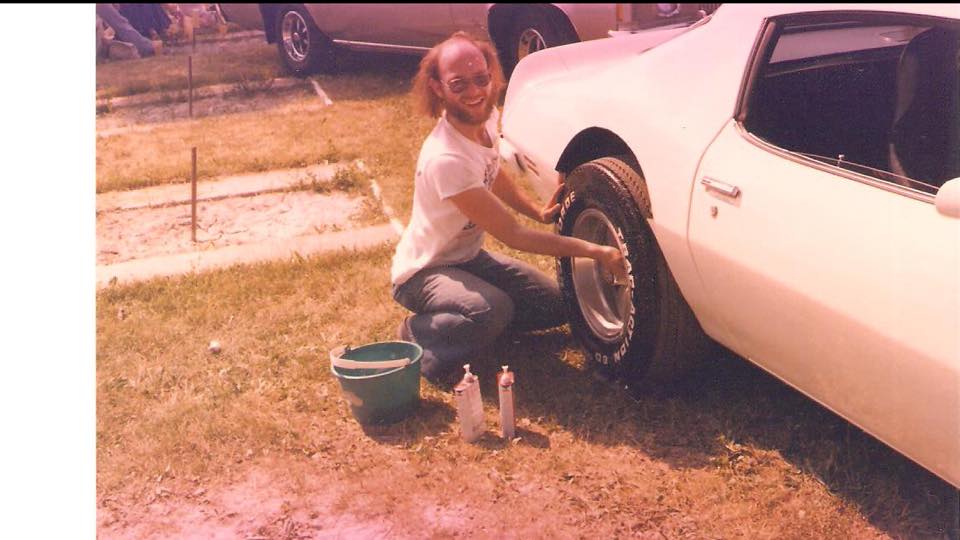
Thanks to the magic of the Internet, the son of one of my best friends asked his Dad if he had any pictures of the car, so here you are.


Me, in full "Hot Rod Hippie" Mode:


Getting cooled off by my friend's wife:


Driving the car ON THE TRACK at Indianapolis Motor Speedway:


These pictures were taken at the Car Craft Street Machines Nationals in 1979.

Head Better, Big Automotive Post In The Works

Well, my head is no longer itching, and several big spots have "bubbled up" for lack of a better term. They'll soon slough off, and hopefully never return.

I'm working up a multipart post to satisfy some Facebook Hot Rod buddies who keep asking about my 1973 Firebird, and whatever happened to it.

It was an interesting car when I ordered it, being one of the last "High Performance" cars of the era. All too soon Federal regulations would clobber performance cars with emissions requirements causing the horsepower to drop to embarrassingly low levels for the engine size (a 460 engine with 155 horsepower??), while safety regulations would result in ugly cars with railroad iron bumpers weighing down each end.

Yes, some of the power drop was caused by dropping compression ratios down for use with unleaded gas (around 10%), and more was caused by the change from SAE "gross" to SAE "net" measurements, but after 1974, power levels seriously dropped to less than half what they had been.

True dual exhausts were replaced by a single pipe with a catalytic converter plugging things up, spark timing was cut down, and compression ratios dipped a bit more.

Things looked really bleak until modern technology like fuel injection, full. near real-time, closed-loop computer control, and better, freer flowing catalysts were developed.

The middle to late 1970's were pretty scary to Car Nuts like myself, but eventually things got sorted out and performance began to return.

Who'd a thunk it that one day we'd have 707HP Dodges, and 650HP Corvettes running around, perfectly happy on 91 Octane pump gas, and not only having straight line performance that truly blows the old Muscle Cars away, but they also have vastly improved cornering and braking abilities.

Saturday, April 1, 2017

Itchy and Scratchy

I had my "Photodynamic" skin treatment today on the top of my head, and the post title is how it's feeling right now.

When I first moved to California in 1982 I was an avid, regular beach goer. And I overdid it a few times.

They were two times when I got so sunburned my first summer here that the top of my head was purple.

YEARS later, I started noticing these hard, scaly patches on my poor old bald head, and went to see the Dermatologist. He proclaimed I had "Actinic Keratosis", and proceeded to blast several spots with Liquid Nitrogen to freeze them off.

That's how I've been having them taken care of for the last 12 years or so, but the last time I saw my Dermatologist, he suggested this method, as it usually gets rid of them once and for all.

They washed my scalp with some mild soap, gave it an alcohol scrub, and then dabbed on "Levulan" topical solution, and let me sit for about 30 minutes for the affected areas to absorb it. Then it was on with the goggles, and roll this 7-tube lighting fixture over me. It puts out a specific wavelength of UV, which activates the now absorbed chemicals. I had two 30 minute treatments with a leg stretching pause in between them.

Compared to the sensation of having LN2 sprayed on your skin, this was a walk in the park!

Minor itching/stinging after the light had been on for about 15 minutes, but that's all, even after the full one-hour treatment.

It may or may not get more pronounced over the next few days before the "bad" areas slough off, but so far it's way better than getting patches of your skin taken down to -320*F!

I have a follow-up visit in 8 weeks, and if there's a few spots they missed, they'll do it again.

Hopefully this will eliminate the LN2 treatments I had been getting....

Sunday, March 26, 2017

Grandson Noah Saying "HI" To The Camera

Not really, but it makes a cool post title.....


Wife Headed Home

After a short stay for the baby shower in Fort Collins, she's on her flight, in the air, and headed back to LAX.


She should be here around 1600, so I'll get to the terminal parking area around 1530, see what gate she's arriving at, and go plunk myself down near the gate and wait.

Would have greatly preferred to have her return via LGB, but when you book your flight 12~14 hours before departure, AND you're trying to get a good price, you can't be too picky!

Friday, March 24, 2017

Miscellaneous Ramblings

Well, got the wife off to Colorado this morning, no thanks to Frontier Airlines. I've only flown on them once, and it was enough. She'd booked this flight a couple of months ago, as Saturday is the baby shower for little Noah, who arrived a wee bit early.

Her flight on Frontier was scheduled for an 1100 departure from John Wayne Airport down in Orange County, and they texted her a cancellation notice last night about 1800 citing a "Spring snowstorm" as the reason for the cancellation.

HUH? Now I know the National Weather Service has been getting a lot of flack lately for their "ZOMG!!!" weather "forecasts", and especially for their "ZOMG!!! SNOWMAGEDDON!!!!" forecast stunt they pulled a coupe,of weeks ago which literally shut down parts of the East coast. I looked at the satellite pictures, and the weather radar data, wet my finger and stuck it in the air, and decided that *if* Denver got much snow, DIA could handle it well, keeping the runways plowed (you get pretty good at the stuff after a while), and I certainly couldn't see any reasonable cause to cancel that particular flight considering that NONE of the other airlines serving Denver even had any delays expected.

I jumped on the old Intertubes and found her a flight on United leaving at 0947 from LAX this morning, nonstop, and while it cost almost double what her "economy" fare on Frontier cost. it had seats available, and gave you one free carry on bag.

Oh, did I mention that Frontier now charges $25 for a carry on bag?

Say what??

The only reason I can see for this is that they're stuffing the belly of the aircraft full of cargo, and the less stuff the passengers bring on board, the more cargo they can cram into the plane. I'll be on the Iowa all day tomorrow for Viet Nam Veteran's Day (Thank you all for your service), and one of our radio operators is a retied 747 Captain, so I'll ask him what he knows about this. He keeps up on industry trends, so he might know.

Our daughter-in-law laughed when we told Frontier had canceled the flight, saying it's been in the middle to upper 70's the last week!


So anyway......she's safely in Fort Collins now, and got to hold little Noah for the first time. She told me "He's barely bigger than a breath!", and that he opened his eyes and smiled at her, and reached out to grab her hair.

My wife was immediately overcome with "Grandma Love", so I imagine after she gets back Sunday afternoon we'll kick things up a notch to start getting things packed up in preparation for shipping a couple of "pods" there ahead of us. We're going back the last week of May to see the kids again and do some serious house hunting, and I know her holding the little guy today just increased her desire to move there by, oh, maybe 200% or so.


And in the Automotive News section today.....

Edd China has announced that after 13 seasons he's leaving "Wheeler Dealers", one of my favorite "reality" auto restoration shows.

When Discovery Network took over the show they wanted to glam it up a bit, claiming that there was too much time spent in each show showing Edd working on and modifying the car.

Hey, idiots, that's what we watch it for!

So, due to the infamous "creative differences", Mr. China has decided to leave the show and focus on his other enterprises and new projects.

Good luck, Edd. You WILL be missed!

I take issue with some of their past episodes where Mike Brewer overstated what work was done on the car as he gave the sales pitch to the buyer, but still, I always found it entertaining, and learned more than few good tips from Edd.

So, that's a wrap for this entry. I'll be yakking on NI6BB all day tomorrow, thanking our veterans, and enjoying the live music and food that are always a pert of these events.

To all our veterans, thank you for your service!


Saturday, March 18, 2017

Nothing In The World Sounds Quite Like This.......

Except maybe a Titan IV launch.

The first rocket I watched live was an Atlas Centaur that lofted a NAVSTAR Block-1 bird from Vandenbeg AFB. My first wife's Uncle Tony worked for Rockwell, and was able to get us passes to the VIP viewing area.

I saw one more Atlas launch, and then a Titan launch, at Vandenberg before he transferred from that program to another one.

I didn't get to see any more live launches until I started to work at Sea Launch, where I went on 18 launches.

I stumbled across this on YouTube and it reminded me of the Titan launch I saw.


Wednesday, March 15, 2017

First Start and Run of Hagerty's Rebuilt Hemi!

Whoo-Hoo!

They got so many requests to hear it run that they made this short video.

Full screen and high volume works best for me....


Saturday, March 11, 2017

International Crystal Going Out of Business

If you use quartz crystals for any of your vintage radio gear, you'd better get your orders in NOW!

International Crystal will be closing their doors in the very near future.

This is quite a blow to the Amateur Radio community, as IC not only makes superb crystals, but they have information on probably 99.999% of all radios, scanners, walkie-talkies, and just about any other device made that uses a quartz crystals, and make make custom crystals having the exact properties required to work correctly in the gear.

They could supply crystals that :just worked" for that old BearCat scanner, piece of obscure military gear, or any Drake, Hallicrafters, Heathkit, etc, etc, etc rig ever sold.

They will be sorely missed!

Looks like JAN Crystals is about the only place left.....

Friday, March 10, 2017

Wisdom

From a FarceBook buddy....


And on a side note, I was checking the spam bucket on my email today, and found one from Senator Diane Frankenstein.

How thoughtful of my email provider to automagically dump that particular email in the spam bucket!

Thursday, March 9, 2017

Grandbaby Update

He's a fighter!

Yesterday he ripped out his breathing tube, so they put him on a nose rig to supply him with O2, and they're closely watching his blood gases.

He's gained 5.5 ounces, and is doing better than expected.

His Mom came home from the hospital, and will be off work for a while while she heals up, but Mom and Dad have been going to see the little guy daily.

This is the most recent photo I have, taken right before he ripped his tube out.


His Mom just posted a "today" photo:


Friday, March 3, 2017

Welcome Baby Noah!

Well, here he is:


2.2 pounds, and 12" long. He'll be spending some time in the Baby ICU until he can fully cope with "Life on the Outside" on his own.

Mother and child are doing well, considering the circumstances.

My wife is ecstatic.........

Thursday, March 2, 2017

Uh OH! The Grandbaby Is Coming Early!

About 65 days early, and it's happening RIGHT NOW!

More to come..........

Possible baby in distress, as they just started a C-section.....


ANNNNND.....It's a BOY!

Which we've known was coming for months, but were requested to keep mum about.

No word on anything else yet, but judging from my stepson's text messages, everything is OK.

Official word is "Mother and baby doing fine", but the poor little guy is only 2.2 pounds...........that's worrisome.

2.2 pounds and 12" long. He'll be in the Baby ICU for a few weeks until his little lungs are strong enough to fully cope with life on their own.

Mother and child are doing fine, considering the circumstances.

Monday, February 27, 2017

Stilton's Back!

"Hope n' Change" was one of my favorite blogs during the 8 years of the Obamanation. His humor helped keep me (and countless others) going on with our lives during what will most likely be considered by future historians as some of the darkets days in American history.

Well, with the election of President Trump (I still like writing that!), the Hope n' Change blog had pretty much run its course.

But Stilton promised us he'd be back, and he just launched his new blog.

Without further ado, I highly suggest you mosey on over to "Stilton's Place" and enjoy his new pursuit.

Friday, February 24, 2017

Meanwhile, Out Near San Clemente Island.....

Just going through some old pix of my Sea Launch days and found this one.

We were out by the Naval Bombing Range on San Clemente for sea trial after coming back in 2011. We were required to go out there to fire up all our various radio and telemetry systems as some of the Russian stuff used frequencies not licensed for that use in the US.

Well, there we were, and along pop up these guys:


Obviously some type of training mission......

Thursday, February 23, 2017

Almost The Weekend.....

And we have some more rain coming.

The weather station finally started acting normal again after drying out for a few days.

The night time temps have been in the low 40's the last couple of nights, and in the high 50's/low 60's during the day.

I'll take the big tarp off the Supra Friday and drive her around a bit, then put the tarp back over her.

Working on a few radio projects, and doing another RF survey for the Iowa, this time in a format that's easier for "lay people" to understand.

That's all for now. Just don't have much to write.....

Sunday, February 19, 2017

Big Light In Sky Scares Local Residents.....

Well, maybe not, but it sure is good to see the Sun after so many days of overcast skies and rain.

We have a 60% chance of rain tonight and tomorrow, but they're predicted to be light showers, nothing like the last deluge we had.

And something went wonky in my weather station. The anemometer had stopped working during the last rain, and now the yearly rainfall total is showing something like 185", more than ten times what we've actually received.

We had some major electrical disturbances during the rain, large green fireballs and BUZZZZ-ZAP! coming from a powerline one street over, and several power drop-outs lasting four to five minutes. This has never been a problem before, as the weather station, living room scanner, and my Drake TR-270 Ham Radio VHF/UHF transceiver all operate from a 1500VA APC UPS, and it's a brute of a UPS. It's one of the larger "Smart-UPS Pure Sinewave" units that weighs about 5 times as much as the "Back-Ups" ones commonly available at places like Best Buy.

The scanner and Drake are operating normally, so I'm guessing I either have some water intrusion into connecting cable, or something has gone South in either the remote head, or the control console hanging on the wall inside. I'll pull the "C" cell back up batteries out later, and unplug the wall wart to see if it resets. Otherwise I'll have to get the ladder out and get up there to see if the cable connections got wet and/or corroded. It's been up there since October of 2009, and I bought it new in 2005, so it might just be ready for replacement.

This model is no longer available, but it looks like they have a newer version of the cabled units. I really don't want to go wireless, as that means changing out a battery in the remote head every once in a while, something I'd rather not do!

Friday, February 17, 2017

It's Raining Cats and Dogs!

Or so says my weather station.

Rain was supposed to start last night at 1900, then the rolled it back to 2200, but it didn't start until about 0600 this morning.

As of right now (1522 PST) we've picked up about .65", and it's cominf down in sheets.

I'd give you a wind speed report, but it looks like my anemometer has decided to take the day off, and I'm not going outside to even check it, let alone attempt a repair!

This screen shot show the current NWS weather radar image:


And this one shows the sat image:


So as you can see, whe're in the middle of a storm cell, with more coming.

The barometer is dropping like a rock, currently at 29.30. and it promises to be a pretty wet and windy night.


*****UPDATE*****

We've received 1.7" as of 1645, and the rain rate is now 2.40" in/hr.

"Lake Long Beach" is coming back for a return engagement.....

Tuesday, February 14, 2017

Pretty Much Back to "Normal"....

Or as "normal" as I get!

Went out on my mail run last night, and did the grocery shopping for the first time in, oh....years.

My wife is still fighting off the remnants of this crud, but she soldiered off to work this morning. Since she's the Office Administrator, when she's gone for a few days the place kinda runs on autopilot, but always seems to hit some turbulence requiring her to answer the phone even when she's out sick.

Looking forward to Wednesday, when I give LL the Grand Tour of the Iowa. I'm sure he'll enjoy it, and since I have access to nominally "Off Limits" areas, I'll show him some of the more interesting things.

Friday, February 10, 2017

Feeling Better, Finally....

Getting back to being myself after almost a week since this bug bit me.

Not coughing all night long, but I'm still congested and a bit worn out.

Nothing else to post today....maybe something later.

Monday, February 6, 2017

Major BLECH

Been in bed all day.
 Nose is still running like Niagara, every single muscle in me hurts, I have a pounding headache, and it took ten minutes to write threse lines.

Go read the good people in the links....I'm going back to bed..........

Sunday, February 5, 2017

Miscellaneous Stuff

Family medical emergency is somewhat under control.

I'm coughing and sneezing every 5 minutes, all my muscles ache, my nose is running like Niagara, my head feels like a balloon, blah, blah, blah, blah, blah.

I'm sure I picked this bug up one of the two times I went to the ER last week. Most everybody was wearing face masks, and there were signs up advising people to wear them.

My wife just ran out to pick up some NyQuil and Mucinex, and she'll probably be sleeping in the front bedroom tonight so I don't wake her up with my coughing.

My friend Randy who posted, and then mailed me, the pix of a very young drjim in his basement Ham Radio shack also posted the only photo known to exist of my 1969 Dodge Charger R/T.


This was taken in the 1969~70 school year, as we sold the car in the spring after Allstate found out that it was a Charger R/T, and not "just" a Charger, and TRIPLED my insurance rates.


$500/year I could handle with my parents help and my part-time jobs, but FIFTEEN HUNDRED DOLLARS PER YEAR was an astounding amount of money back then, more than a "college kid" could afford. With 100 Octane leaded premium fuel costing thirty eight cents a gallon, $5 a week was enough gas to go to/from school, my job, and cruise around a bit when the weather was nice.

For those that don't know....the car is a 1969 Dodge Charger R/T with the SE (Special Edition) package, 440 Magnum V8, TorqueFlite automatic trans, 3.23 SureGrip ("POSI") rear, power steering, 11" manual DRUM brakes, tinted glass, and an AM radio. The SE package included "leather" (worst automotive leather I've ever seen) seating surfaces on the front seats, a simulated wood grain dash and steering wheel, a lighting package (light over ignition key, door panel lamps, and hood-mounted turn signal indicators), clock, and "SE" emblems. The paint code was "T5 Copper Metallic", and it had a tan interior. It did NOT have the R/T "Bumblebee" stripe because we ordered it from the Dodge dealer (Melvin Teasdale Dodge) in Morris, IL that my Mom grew up with, and since it was "her" car, he checked the "delete stripe" box on the order form, and also specified white wall tires instead of the standard Red Line F-70x14 tires they normally came with. With the stripe delete (There were discrete "R/T" emblems on the rear quarters) and white walls, it was a real sleeper! The best it ever ran at the strip was a 15.60@102MPH as it was severely traction limited with those skinny tires on 5" wide rims. I could spin the tires as long as I wanted to, and it would get pretty boring after a block or three. I wanted to get the 15" Magnum 500 styled steel rims with white letter Goodyear PolyGlas F-70x15" tires, but that would have put me WAY over budget, as that option required extra cost power disc brakes, and I wanted the SE package. My friend Randy and I took this car out one night and I held the accelerator down until it topped out at an indicated 130MPH. I don't know what RPM the engine was turning, because the tach would have cost about $100 extra, and I just couldn't afford it. Window sticker on it was exactly $4004, and I think we got it for about $3600~$3700.

"Mindbender II" was the name of a road rally a friend of mine and I laid out, and "JJC" stood for Joliet Junior College, also called "Ju-Co" or "Super High". It was the first public junior college in the USA, and this was the first year the school was located at its new campus, waaaay out on the West side of Joliet, on a high plateau surrounded by cornfields.

There was nothing to break the wind and snow in the winter time, and it could get pretty brutal for the Midwest, with 30~40 MPH winds, and temps of 10*~20* below zero. The closest parking spot to the temporary classrooms (trailers) was over a quarter mile away, and you typically walked at least a half mile, usually  more, from parking to your classroom.

People who didn't dress properly could, and did, get frost bite walking in to the classrooms from the parking lot.

JJC was a nice transition from high school to "college", but if you weren't careful, you'd treat it like an extension of high school ("Super High"), and fall flat on your face if/when you went away to a "real" college or University.

Monday, January 30, 2017

Sunday, January 29, 2017

Headed Out.....

It's 78 degrees, the sun is shining, and I'm wearing one of my Celica Supra T-shirts.

I just cleaned the windows, and she's idling in the driveway to warm up a bit.

Time to hit the road, shake out any rain water still in her, and blow some cobwebs out of the brain.

Just got back with all the carbon blown out of the engine, and all the cobwebs blown out of the head.

Put about 60 miles on the car, and found it it has a water leak, probably the sunroof, that got the passenger seat and all the junk I had sitting on it, pretty wet.

SO.....I'll be leaving the windows down during the day for the next few days.


And I'll put a tarp over it so the rain won't go where it's not supposed to!

Saturday, January 28, 2017

"Edge of Space" It 'Aint!

Rant time.....

I just received my new QST magazine, and on the cover as the lead story is an article about "Amateur Radio At The Edge Of SPACE!".....

It's an article about a group of high-school Hams who send home brew instrument packages up ~120,000 feet using balloons, and recording the downlinked data.

This is great stuff, and I greatly admire the young men and women who are doing it.


BUT....for crying out loud, STOP calling it "The Edge of Space"!

It's NOT.

It's not even close!

The official definition of "Space", is an altitude ABOVE 100km, or about 62 miles, a bit more than 328,000 feet.

120,000 feet is a bit more than ONE-THIRD the required altitude to be in "space", and as such is pretty far from being "the edge" of anything meaningfully close to "space".

I remember not too long ago when the guy jumped out of the balloon sponsored by Red Bull, and they insisted on using this same "Edge of Space" nonsense.

I sure don't have the big brass ones it takes to do that, and I also greatly admire Felix Baumgartner for having the cajones to do it, but it wasn't, and never will be, "The Edge of Space".

Knock it off, people....you're just demeaning the people who really do go into space for your own cheap amusement....

/rant off

Friday, January 27, 2017

50 Years Ago Today

The Apollo 1 fire occurred, taking three of our Astronauts on their final voyage.


Gus Grissom, Ed White, and Roger Chaffee  perished in the fire inside thier Apollo Command Module.

The cause of the fire was eventually traced to some chaffed/frayed wire that caused a spark, resulting in an extremely hot flash fire accelerated by the pure Oxygen used at the time in the Command Module.

In the race to beat the Russians to the Moon, compromises had been made in the design of the Command Module, including the use of a pure Oxygen atmosphere. At the time it was deemed too expensive, and more importantly, too heavy, to include the required Nitrogen system so the the atmosphere in the Command Module would be "air", and a much simpler pure Oxygen system was used.

The hatch on the side of the Command Module had also been designed to open inward, and had many bolts to secure it closed, making it very difficult to get into the  Command Module quickly from the outside.

And many materials used in the interior of the Command Module were later found to be extremely flammable in a pure Oxygen atmosphere.

Manufacturing carelessness also played a factor in the accident, as quality controls were not up to the standards used today. One of the things that NASA did with the remaining Command Modules in the inventory was to put them on shake tables, and shake the living daylights out them to see if anything was loose. One thing I remember from from my NASA Soldering Certification classes was that several POUNDS of loose solder bits and loose solder "balls" were shaken loose from the Command Modules that were tested.

Every one of these little things was a potential short circuit that would be floating around in the microgravity experienced by the Command Module during it's flight, and the Engineers were horrified to see how much junk came out after the shake tests.

Wiring was also rerouted, tied down, and encapsulated with tubing at any point where it rub against anything to ensure that the insulation would remain intact.

And the pure Oxygen system was replaced with a system that used a 60/40 mix of Nitrogen and Oxygen until the Command Module was in orbit, at which time the Nitrogen was slowly purged, and the atmosphere replaced with pure Oxygen.

Manned spaceflight is an extremely risky business, even when practicing on the ground, and you will lose flight crews. You take every precaution you can, design things with triple redundancy, have detailed checklists that must be rigorously followed, and still, you cross your fingers and say a little prayer when the crew boards the spacecraft.

Man is a curious, exploring animal, driven in his quest by a thirst for knowledge and understanding.

And brave men like these lead the way.

God speed, Apollo 1 crew.

Per Aspera Ad Astrum

Wednesday, January 25, 2017

What A Difference A Day (or two...) Makes

Don't worry, I won't 'entertain' you by singing.

"Lake Long Beach" has sunk back into the Earth, leaving only very minor inconveniences behind.

The wind had knocked the vent stack for the water heater loose, so I had to get the ladder out of the garage, climb yp there, and put it back together. Our across the street plumber friend had knocked the mountings around when he installed our new water heater last summer, and it was just a matter of time before Mother Nature moved it around some more.

This resulted in two things happening. First, when the wind blew, the open end of the stack resonated like a large organ pipe with a rather disturbing thrumming sound, and second, when the gas burner fired up, it sounded somewhat akin to an F-4 Phantom lighting up in the driveway.

The blowing wind sound really bugged my wife, and the jet engine noise bugged her even more, to the point where she stated saying "Oh My God....IT'S GOING TO EXPLODE!".

So up I went to rectify the damage.

And we really ducked a bullet as far as water incursion goes. I had two boxes of "stuff" that got wet. One has a large, heavy Rohn "Non Penetrating Roof Mount" antenna base that was surplus from my wireless service provider days, and the other had some cleaning/waxing supplies in it.

The Rohn box had maybe 1/2" of "water damage" to it, and got securely taped up today, and the other box went into the recycle bin after I moved the items in it to another box.


And the grass is going to grow like crazy over the next few weeks!

Sunday, January 22, 2017

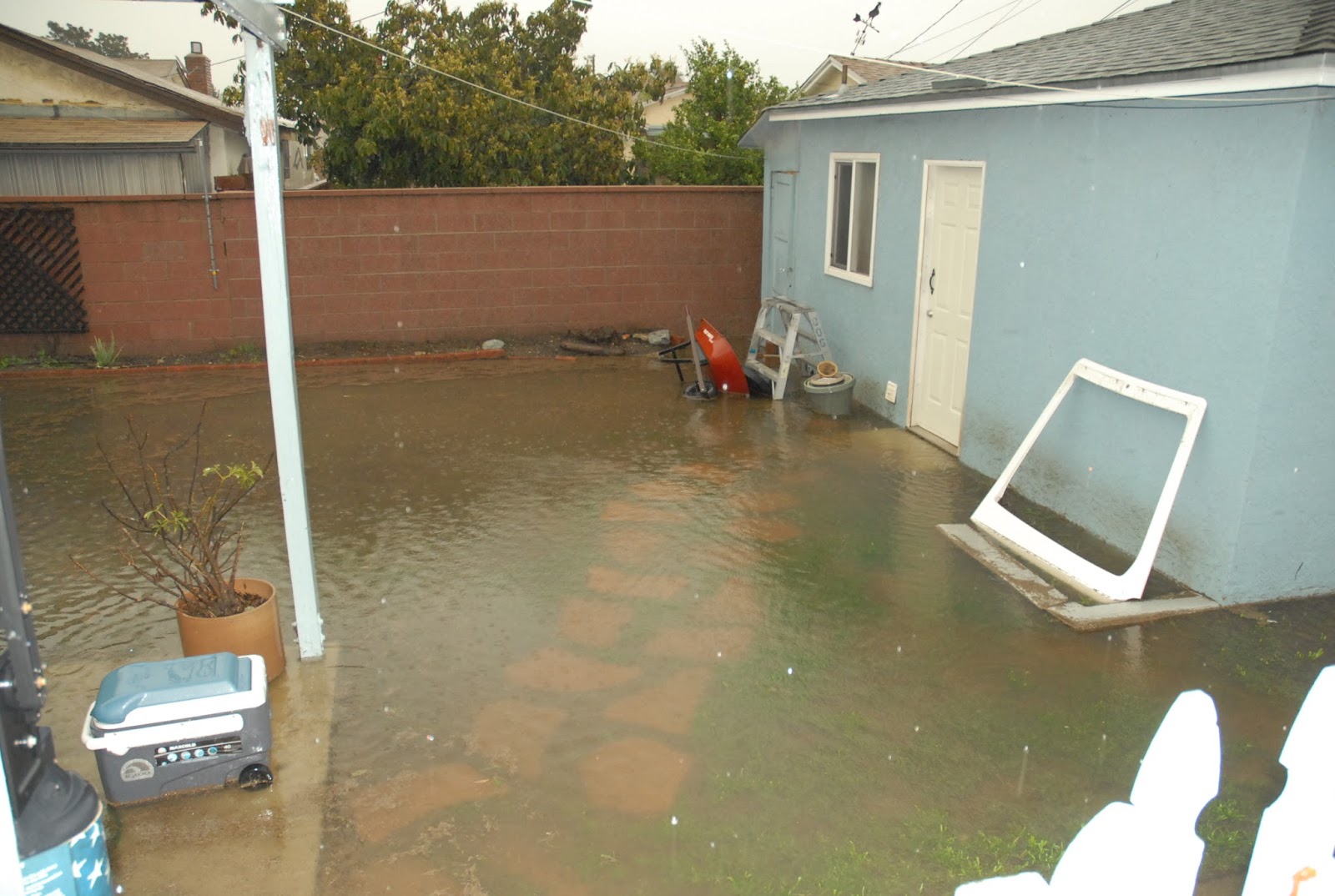
Welcome to "Lake Long Beach"!

Just a bit of water in the back yard....


Even though we make sure the dog always has a bowl of fresh water in the backyard, I don't think she needs it today, and wouldn't want to wade out there to get to it...


The brick border is actually TWO bricks high....


If you know how big a DogLoo is, this will give you an idea how deep the water on the patio is...


Or if you don't know how big a DogLoo is, here's a standard size cooler-on-wheels...


View from the porch steps...


Nope, not doing any laundry today...


Saturday, January 21, 2017

More Rain On The Way ***UPDATE***

Supposed to start again tonight, and then "Heavy Rain" all day Sunday, Sunday night, and "80%" through Monday night, tapering off through Tuesday.

With the ground as saturated as it is, I predict the return of "Lake Long Beach" in the back yard.

My wife told me there were whitecaps on the water in the L.A. River on her way home from work yesterday.......


Well, the rain started again early this morning, around 0300 when I had to get up and let the dog out.

Something about a cold nose in the arm or face just makes me open my eyes to see what's up.

It was off and on until around 0800 when it started coming down steadily, and it's been doing that for the last 6 hours.

So far we've received slightly over 1.25", and it's coming down at about .6" per hour.

And it's expected to continue like this the rest of the day, and through tonight.

And tomorrow, and tomorrow night, tapering off on Tuesday.

"Lake Long Beach" has returned, and might get into the garage if this keeps up......

Friday, January 20, 2017

Obama Legacy Disposal Team

Courtesy of Stilton over at "Hope and Change Cartoons".

Now that President Trump (God, that feels good to write!) and the adults are back in charge, "Hope and Change Cartoons" won't be published as much.

It was a great run, Mr. Jarlsberg. Thanks for doing it!

And in other news, we got TWO INCHES of rain last night. The back yard is now a lake....


Thursday, January 19, 2017

See Through Engine - 4K Slow Motion Visible Combustion

Ran across this on YouTube while looking for something else.

It's really cool to watch the flame propagation from the ignition point through the chamber.


Tuesday, January 17, 2017

Anybody Ever Leave Las Vegas Headed NORTH On A Sunday??

I know you sure don't want to head out SOUTH, back to L.A. on a Sunday!

The reason I'm asking is that registration for "Supras in Vegas 2017" just opened, and I went ahead and registered.

Since God willin' and the crick don't rise we'll be living in Fort Collins at that time, I'm planning my route from Fort Collins to Vegas.

Since it's 803 miles, I'm not going to do it in one shot! If I were 20 years younger, maybe, but driving through that terrain, at night, alone, is NOT something I relish doing anymore.

So far, I'm planning on overnighting in Green River, Utah, which is almost exactly half way between Fort Collins and Vegas.

I'll leave Fort Collins on Tuesday, and then roll into Vegas on Wednesday. The event starts Thursday, so I'll have Wednesday night to get a good night's sleep.

The event ends Saturday around 1700, and then we always have a "Mark II get together dinner" at one of the hotel/casinos about halfway back to the Excalibur from the Las Vegas Motor Speedway.

I'll roll out of Vegas Sunday, stop again in Green River, and should get back to Fort Collins on Monday.

Hopefully the traffic headed NORTH out of Vegas won't be nearly as bad as that insane crawl back to L.A. would be on a Sunday afternoon.

I'll have to ask some of the regulars to the event if they've ever gone North on a Sunday.....

Saturday, January 14, 2017

Early Chrysler "FirePower" Hemi Time-Lapse Rebuild

Another great time-lapse rebuild from Hagerty, this time of an early Chrysler "FirePower" HEMI!

I'll bet it really sings with that exhaust system.

Watch it in full screen for best viewing.


Thursday, January 12, 2017

Rain and Other Stuff....

We've received over an inch of rain from this last storm system, bringing our season total to slightly over 8".

The NWS is calling for a 50% chance of more tonight, and then nothing until this time next week. Further North, the bay area's been really getting hammered, with more rain this month than our season-to-date total.

And there was another screwy "low speed" chase the other night. Some 30 year old known gang banger shot his sister-in-law, and then melted into the woodwork. The cops had a BOLO out on him, and he popped up in Reseda, up in "The Valley".

He took off with a squad in pursuit, and then proceeded to enter the 405 Southbound, where he slowed down to 5~30MPH for the next two hours, throwing stuff out of his car, and taunting the police the entire time. They finally got a couple of BIG SUV's after him, and did the -tap-and-spin maneuver to stop him, and then let the dogs loose.

I haven't heard anything else, but I think he'll be going bye-bye for a while.

And we got the antenna rotor "fixed" down at K6AA. It turns out it was a non-problem caused by letting the antenna sot at a fixed position for long periods of time.

There's a potentiometer inside the rotor motor unit up on the tower that's used to supply position feedback to the indicating meter in the control head. As the motor rotates, so does the pot, sending a variable voltage to the meter. It's a "wire-wound" pot with a brass "wiper", and when it sits too long in one position, a small amount of corrosion forms between the brass wiper and the NiChrome wire of the winding. Since the applied voltage is only about 6 Volts, it's not enough to "punch through" the corrosion, and the voltage never gets back down to the meter. All we had to do was run the rotor through its full range of travel a few times, the wiper cleaned the wire winding, and the "problem" went away.

We made a note in the station operating manual that to prevent this issue in the future, the rotor should be cycled through its full range weekly, but I'll bet this happens again within six months....

Monday, January 9, 2017

blech......Getting Over a Cold

Been a bit under the weather, so I've been taking it a bit easy.

We got clobbered with another .75" of rain last night. Started about 0300 and woke me up it was raining so hard. No flooding and no mudslide I've heard of, so all is well here.

Have a brunch appointment Tuesday morning at one of my favorite little places, The Think Cafe in San Pedro, and then on to the L.A. Maritime Museum to troubleshoot the antenna rotator....again!

From the descriptions given by the operators at K6AA, the rotator is malfunctioning. It might be a loose wire on the back of the control unit, or the direction indicating potentiometer up in the rotor head may have gone TU. Since none of us are "certified" to climb the tower, and lack the now required insurance, if it is the rotor head, that'll mean hiring the guy we use to come out and swap the rotor head out with one we'll have to order if our troubleshooting leads to that problem.

Here's hoping it's just a loose connection on the back, as between ordering up a rebuilt rotor and paying the guy to swap it out, that's about $600 the club would rather not spend!

Saturday, January 7, 2017

Stuff That "Our Side" Knows and Understands

You've probably seen this before, but it's always nice to see it again.


Graphic courtesy of Matt Bracken and the good folks at WRSA.

Phony Facebook Accounts

So far I've had five pop up out of nowhere. It took about 4 hours for them to respond the first time and kill the fake account, but now they're stamping them out about as fast as they pop up.

I think it also helps that several of my friends have notified them, as they're killing them off in minutes now.

Oh, well.....

Friday, January 6, 2017

Anti Trump Tripe

From a (former) friend on FarceBook comes this.

Indivisible: A Practical Guide For Resisting The Trump Agenda.

I'm not going to link to it. You can Google it. I know, it's a good thing to read and try and understand what "The Other Side" is up to, but every time I do that I get nauseated. I'll leave it to those with stronger stomachs.

Anyway....it's supposedly written by "Former Congressional Staffers" who "know all the tricks" to getting Congress to "listen".

Notice the emphasis on the word "tricks"? Not advice, or suggestions, but the TRICKS, by God!

Typical lib-speak, as it implies the easy way. Rather than relying on logic and facts, we'll just "trick" them into listening to us., wink-wink, nudge-nudge.

I'm so sick of this friggin' BS it makes my blood boil.

Tuesday, January 3, 2017

Got Nuttin' Today....

Just been tinkering on yet another ( ! ) laptop for my friend's animal rescue place.

This one had a hard-disk that was on it's way out, so I ran to Best Buy yesterday to grab a new drive, and now it's finishing up all the Windoze Updates.

I bought a 500 GB Seagate drive for FIFTY BUCKS....think about that a second.

The first brand-new hard drive I ever bought was in December of 1996. Fry's Electronics was having an after Christmas sale, and I bought a Western Digital 1.6 GB drive for TWO HUNDRED BUCKS.

And that was a very good price at the time.

So, what this means is that the drive I bought has over two-hundred and fifty times the capacity for one-quarter of the price.

In other words, the "raw" price-per-bit has dropped by a factor of one thousand in the twenty years since I bought that first drive.

And the reliability and performance have increased by a great margin, too.

I haven't bought any memory lately, but the first memory I ever bought was sometime in 1995 for my son's first computer.

I paid $35 per MEGABYTE for it.

4 meg of memory cost me about $150 out the door back then, and IIRC it wasn't even EDO (Extended Data Output) memory, just "regular" FPM, or "Fast Page Memory".

Today, 4 GIG of memory is about $25 at Newegg, or  greater than FOUR THOUSAND times cheaper.

And it's much faster memory, to boot.

I'm not sure if this makes me feel old or not......

Sunday, January 1, 2017

***YAWN*** Happy New Year!

Lots of fireworks around here last night, and something I hadn't noticed in previous New Year's Eves.....gunfire!

Drove the dog nuts, and I had to give her a couple of Benadryls to get her calmed down.

I just hope the "people" shooting off guns were shooting them into the ground.

Every time I heard somebody start to dump a magazine, I'd start counting shots.

EVERY time it was 15 shots or 17 shots. Every. Single. Time.

So, hey Kommiefornia....how's that "High Capacity Magazine" ban working out for you? Pretty good, huh?

And I could have sworn I heard somebody rip off a string of shots in full-auto.

Considering were only a mile or so South of infamous North Long Beach, it was probably a banger bangin' away....

SLW's BFF Passes Quietly

 On Friday, the 29th, and 1215pm local time. Surrounded by family and friends, and her two dogs. Things have been a bit hectic here, as expe...