Tuesday, September 13, 2016

Rear Suspension Work

Well, I'm shutting down for the night. I didn't get as much done as I had hoped for, but then that's nothing new for me....

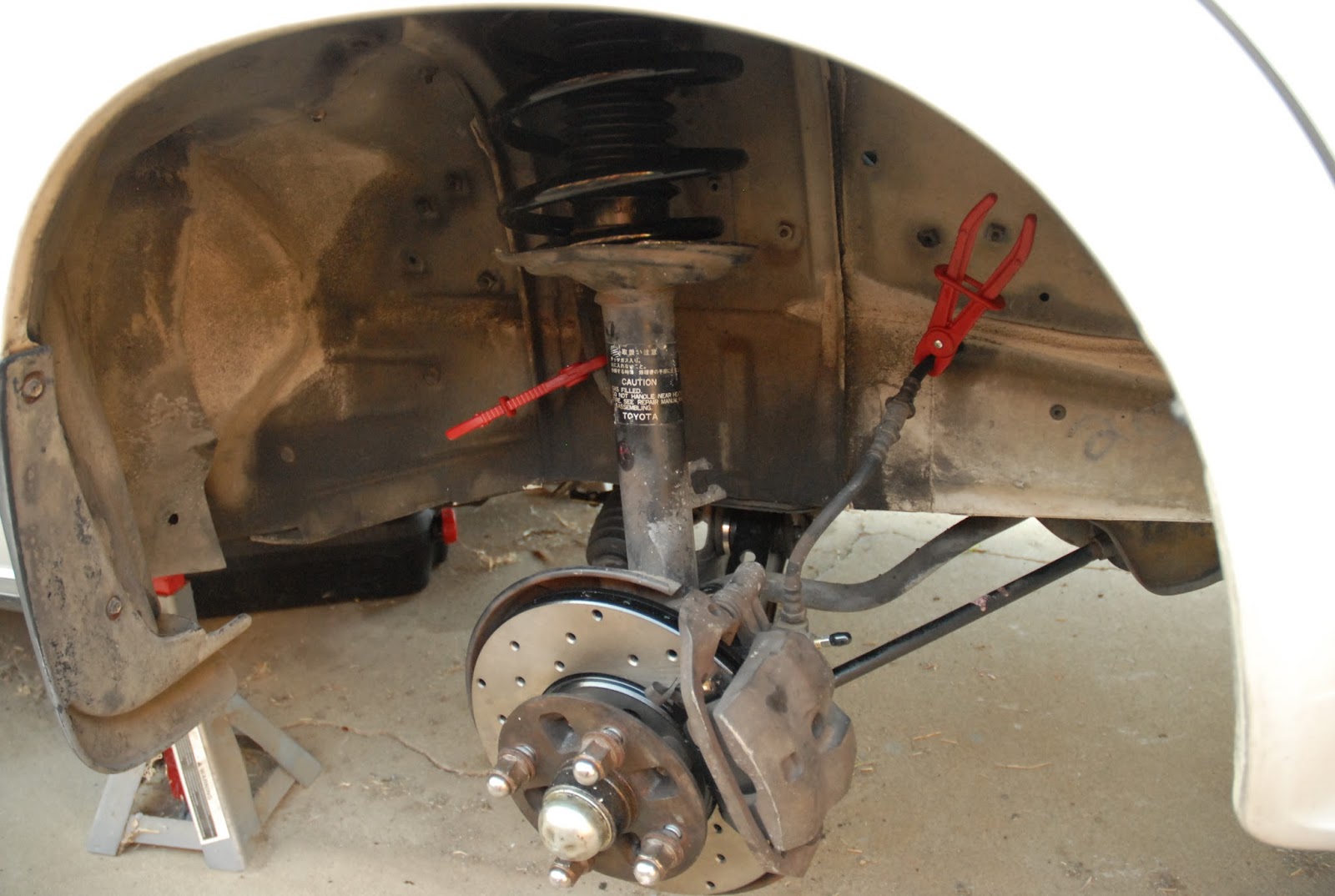
I followed the TSM, and dropped the outer flange for the half-shaft, and as soon as the shock was loose at the top, I lowered the jack, and the spring about fell out.


The upper isolator/cushion was in pretty good shape for being 30+ years old.


 But, WOW...the bottom one was toast!  I'd say it deserves retirement after 30+ years and 167,000 miles of faithful service.


 Had to do some finagling to get the shock installed, and it really would have helped if I'd had an extra floor jack, or a bottle jack, but I finally got the shock installed, and all the hardware tight.


 I also replaced the top bushings for the sway bar end links. They were really shot, and you could rattle them around a good 1/4"!

Some info on the new and old springs for those that keep track of this stuff.

The OEM springs are wound from wire that's .570" / 14.5mm in diameter, and have an overall free length of 14.25" / 360mm.

The new Dobinson C59-059 springs are wound from wire that's .604" / 15.3mm in diameter, and have an overall free length of 12.6" / 320mm.

Bigger wire, and a shorter OAL equals a stiffer spring, so even though it's specified to drop the car about .75", the rate should be higher. I know from my "bounce test" the other night that the front seems a lot stiffer, but I won't know for a day or two until I drive the car.


Final picture for the night I'm going to call "3 Down, and 1 To Go!".....


At this point all I have left to do is a preliminary bleeding of the brake caliper using the MityVac, and recheck everything to make sure all the hardware I touched is torqued properly. I'm playing hookey again from the Iowa on Wednesday (sorry, guys...) so I can get the left rear knocked out. As with the front, now that I've done it one time, the next time will be easier.

Onward...To The Rear!

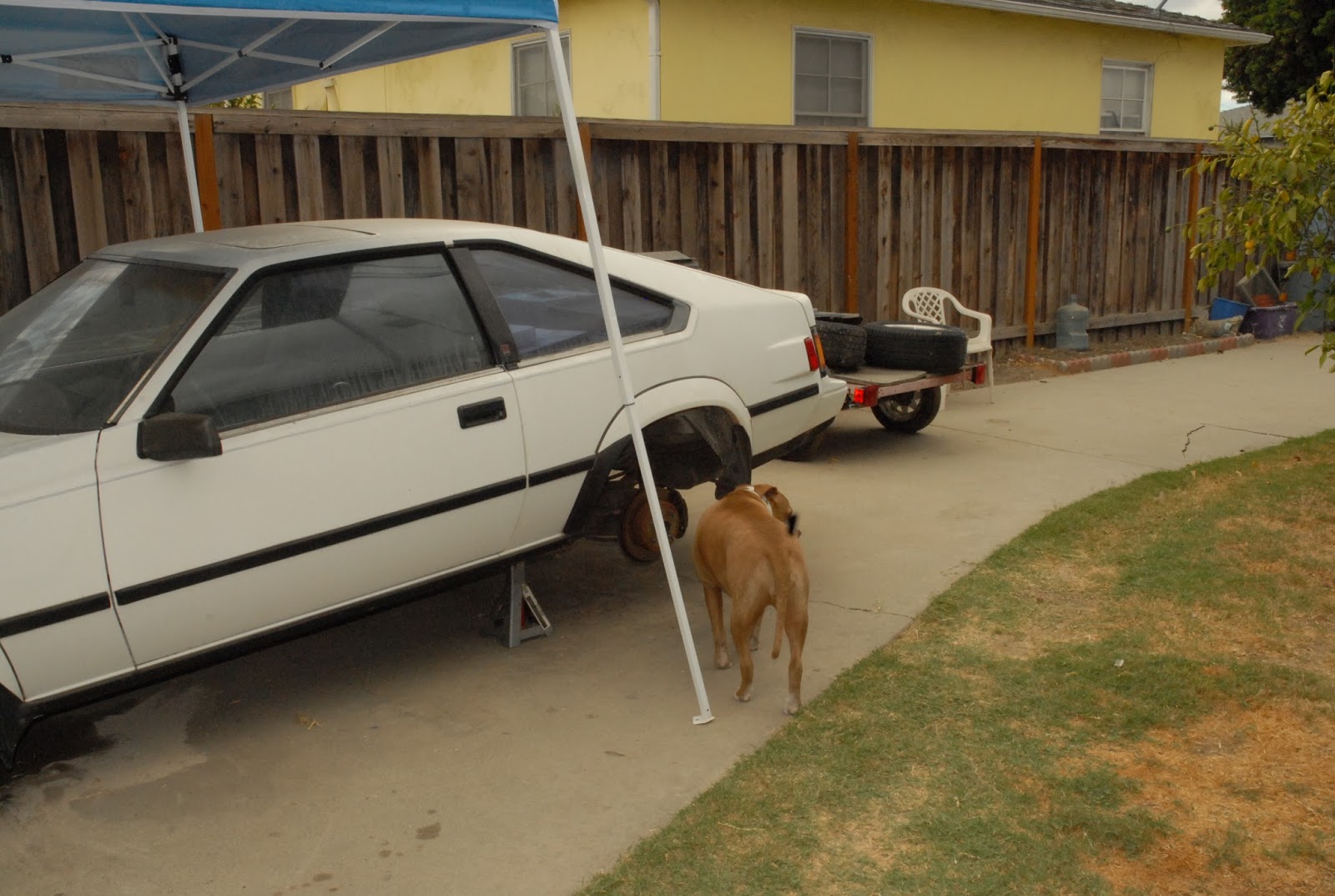
Tail end is up and on jack stands.


Notice "Inspector Pebbles" checking my work to ensure proper safety standards are being followed!

And yep, I've either got a spot of something on my sun filter, or the sensor in my Nikon needs cleaning.

Initial inspection shows the rear pads and rotors to be in excellent condition, but man.....the rear spring lower isolators/cushions (kind of like a big rubber ring) are TOAST!

Theyre both cracked and split, and it's a Good Thing they're one of those parts I ordered long ago because I suspected they might be a bit worn after 30+ years, and 167,000 miles.

The factory shop manual says to remove the rear sway bar end links, remove the rear shocks, and the springs should come right out if the suspension is hanging free, like it is.

As far as replacing the rear rotors with new ones I have, all I should have to do is remove the bracket that holds the caliper in place, and the rotor should pop right off if the emergency brake is released.

I'm not going to replace the rear control arm bushings at this time, as it's pretty involved, and I'll do those, along with the subframe mounting bushings, and differential mounting bushings, after I get back from Supras in Vegas.

Doing all that, along with replacing the steering rack, is probably a several week project at the rate I work at.

She's On The Ground!

Scrubbed all the grease and glop off the power steering hose assembly, and then rebuilt it with the new high-pressure hose, and a length of "SAE J189 Low Pressure Power Steering Return Hose".

And I used the same hose on the short piece that connects the outlet of the cooling loop back to the reservoir.

Then I spent a couple of "pleasant" hours (I must be deranged...) putting everything back together. Actually, it wasn't that bad, as it's always a good feeling putting nice, clean, freshly rebuilt stuff back on the car!

Filled the reservoir and started the car, carefully checking for leaks.

WHOOPEE! No leaks!

So then I ran the steering wheel from lock to lock a few times, and watched all the foam in the reservoir build up and dissipate, indicating the air was getting bled out of the system. Topped off the reservoir, checked all the fittings for tightness after I shut the engine down, and all was good.

Fired up the engine again and bled the brakes by cracking open the speed bleeders, connecting them to a small jar to collect the expelled fluid, and slowly pumping the pedal a few times, checking the fluid in the master cylinder reservoir to make sure it didn't get too low and suck air.

Got a few more bubbles out of the brake system and decided it was bled.

Rolled out one "left" and one "right" wheel/tire for each side (the tires have a directional tread pattern, so there's a "left" and a "right"), got out my new lug nuts and wheel locks, and "hub centric rings", and immediately noticed a problem.

The lug nuts I bought have the correct 1.5 thread pitch for the wheel studs on the car, but the wheel locks I ordered were a 1.25 thread pitch.....RATS!

Fortunately I have more than enough lug nuts, but now I'll have to order some matching wheel locks in the correct thread pitch!

Drove the hub-centric rings into the back of the new rims with a soft mallet, and mounted the new front wheels and tires on the car. Dropped her down on the ground and torqued the lug nuts, and I'm done for the night!

Tuesday morning I'll do the final torquing of the lower control arm bolts, and the large nut on the end of the strut rod, and other than a front end alignment, the front of the car is (finally!) finished.


Say "Goodnight, Gracie".....

Sunday, September 11, 2016

"Grease Pit" Work.....

Didn't get much done on the car yesterday. I was on the Battleship Iowa from 1230 to 1715 helping guide a tour from a local radio club down into "The Bowels of the Ship".

Well....not all the way down, but two decks below what most people get to see, where the Transmitter Room is located.

I did make some good progress today, though. I now have the sway bar end links installed, the new bellows boot for the right side of the steering gear replaced, and both hoses for the power steering off the car. I needed to replace the high-pressure hose as the place I originally took it to for smog said the hose was "Leaking fluid and spraying it EVERYWHERE!", and refused to work on it citing safety concerns. I could never find evidence of it leaking any more than a very small amount of fluid, and suspect they really don't want to work on 30+ year old Japanese cars. Oh well....

I pulled both the pressure and return hoses as an "assembly" because they're held together by clamps every 6~12", and by removing two small bolts, they came out as one piece once I had the fluid connections disconnected.

 I found it MUCH easier to replace the hoses (if you're going to do one, you should probably do BOTH...) if I did the following:

1) Remove the air cleaner assembly. This gives much better access to the low pressure return hoses going to/from the loop of tubing Toyota laughingly calls a "cooler". It's better than nothing, and I do plan on replacing it with a real cooler. I had a cooler from a Cadillac on my 1973 Trans Am, and it made a noticeable difference in how the steering felt on hot days when I was autocrossing the car.

2) Slurp out as much power steering fluid as possible from the reservoir, unless you like a waterfall of fluid going everywhere as you're laying on your back under the car when you pull the hoses from the rack. -OR- you can plug the outlet of the pump as soon as you pull the high pressure line. Keep in mind the lines themselves are still full of fluid, but at least you won't have the entire reservoir take a dump on you!

3) Disconnect as much as possible from the top first. Pull the flare nut fitting from the pump, and pull the hose going to the cooling loop.

4) Remove the two 10mm bolts holding the clamps to the steering rack. These clamps holds the supply and return hoses together. Wipe the area down before starting to remove the bolts, as you won't get as filthy actually pulling the parts out.

5) Disconnect the flare fittings at the rack, making sure you have a drip pan, and/or plenty of paper towels (see #2 above!). Undoing the return line first will allow you much better access to the high pressure line.

6) Pull both hoses together as an "assembly". This will allow you to look at them out on the ground so you get a better idea of how to install the new ones, and give you a chance to easily clean off all glop that's covering all the various bits and pieces. Mine seemed to come out easiest from the bottom, but YMMV!

7) Put your new hoses together using the old clamps, and route them the same way as the old, dirty, filthy rotten ones were. Tape up the ends of the new hoses to keep crud out of them!

8) Install your new, clean hoses as an "assembly". Fill the reservoir with Dexron or equivalent, and bleed the air per the TSM.

If you try and do them one-at-a-time, you'll be pushing, pulling, and fighting the old hoses out, and the new ones in, and using more than a few choice words. I spent probably way more time than I should have looking at how these were installed in the car, what held them down, how they were held together, and what had to be removed to do this the easiest way I could.

Face it, I'm "lazy", and I'd rather spend some time figuring out the "easy way" (as long as it's also "correct") to do something before I start on it, rather than have a D'OH! moment half-way through the job where I see a better way of doing something.

There's NOTHING in the TSM about removing/installing the hoses other than the cryptic "Remove the high-pressure hose", and "Remove the return hose".

When I saw how they were clamped together, and the clamps not only held them together, but held them in place, I figured it was easiest to just call them an "assembly", and pull them out together.


The connections on the right side go to the steering gear:


 and those at the upper left go to the pump, and fluid cooler:
 

Monday I'll scrub all the glop off the hardware, assemble the new hoses, and put it all back together. Then it's down to putting the wheels and tires back on, dropping it to the ground, and doing the final torquing of the suspension bolts, which requires the weight of the car to be on the suspension.

Then it's on to the rear, where my friends who've done this before assure me that even at my snail's pace work speed, I can swap out the springs and shocks in about 4~6 hours.

Then to the alignment shop, and a week of "shakedown" cruising to make sure it all works right!

Friday, September 9, 2016

Loose Ends......

Always seems to be that the "last 10%" of things to get done on a project always take more than 10% of the time!

Spent the whole day (so far....) farting around cleaning up various bits and pieces of The Great Front End Rebuild.

Like the bellows boot that covers the inner workings of the right side of the power steering rack and pinion gear.

The boot was torn in half when I bought the car, BUT unless you were looking right at it, or the wheels were turned full lock to the left AND you were looking right at it, you didn't notice it. The only evidence at the time was a few drops of liquid under the right side of the car. The boot had been ripped long enough that dirt and grit got at the seal on that end of the steering gear, and wore them enough that now it drips.

I have a rebuilt steering gear waiting in the box in the garage, but I'm not going to swap it out until I get back. Yeah, I know I'll have to eat the cost ($85) of another 4-wheel alignment after I change it, but the one in the car now doesn't leak much fluid, it'll be another "Big Deal" to swap it out, and it's NOT a safety issue, as the inner tie rod ends are (still) tight, and there's no slop in the steering, so the dirt only got to the outermost seal.

The "hardest" part of swapping out the bellows boot today was removing the outer tie rod end, and getting it back in exactly the same position it was in so that it didn't throw the existing (unknown quality) front-end alignment off.

I painted a stripe on the inner tie rod end, and used the "Edd China Method" of removing and replacing it.

I counted the turns until it came off, and then screwed it back on the same number.

Simple and effective, and will work more than "good enough" to get me to the alignment shop next week.

One more item crossed off The List.....

The last thing I really have to do other than doing the final torquing of the lower control arm bolts and the strut rod nut, is to replace the power steering high-pressure hose. This is the item that my "original" smog test place said was "Spraying Fluid EVERYWHERE!", and refused to smog the car on safety grounds. Even though I could only see a very few, very small droplets of fluid, I grudgingly accepted their decision as I had a power steering hose blow on me once. And because that car (another Toyota Celica, no less!) also had a cracked exhaust manifold on the same side of the engine as where the hose was, the fluid lit off under the hood with rather spectacular results. One of my neighbors saw it happen as I was coming down the street and said he thought they were filming some kind of action/adventure movie, and I was part of the special effects......

So, yeah, that hose has GOT to be replaced!

And while I'm down under the car in GreaseLand, I'll also replace the return line.

I was planning on starting the hose replacement Saturday, BUT "duty calls", and I've been asked to help provide some help escorting some visitors on the Iowa, so this gets put off (le sigh...) until Sunday.

On the plus side, I've lost 12 pounds since I started actively working on the car (again), and I can now bend over and touch my toes again.

Which might come in real handy if The Hildebeast sneaks in to the White House this fall.....

Thursday, September 8, 2016

Brake Bleeding

Got the front brakes bled today.

Between the Russell "Speed Bleed" screws, and the MityVac, it's a one-man operation!

I started by slurping out as much fluid as I could from the master cylinder reservoir with the MityVac, and then wiping out the reservoir with a clean shop towel.

The fluid that came out looked like VERY bad coffee, and the plastic reservoir was filthy with rusty colored slime.

Took most of a quart of new DOT3 fluid before it was coming out clean from the bleeder screw on the caliper, and the drivers side is the closest to the master cylinder.

Generally, you start bleeding at the brake that's furthest from the master cylinder, usually the right rear, but I've done it different ways at different times, and it never seemed to make a difference where I started from.

So, one more item crossed off the list!

Wednesday, September 7, 2016

New Shoes for Ms. Swan.....

The new rims are "XXR-531", and the tires are Toyo Proxes T1R.


And between the suspension rebuild and the mods, she ought to be able to really dance now....


The OEM wheels were 14x7, and the tires were 225/60-14.

The new hardware is 16x8, and 245/45-16.

Here's a "top view", kind of, of the OEM vs new:


The new tires are 20mm wider, about .79", and are "45 series" instead of "60 series".

I picked this size tire as it has the same "rolling radius" as the OEM tires, which means the speedometer should read the same.

HOWEVER...they look a little "shorter" to me, which means my "optimistic" speedo will be even more so. Oh, well...makes it harder to get a speeding ticket when the speedo indicates 65, and you're really doing about 62, as it is now.

The tires are also much newer technology even though they're both radial construction.

Monday, September 5, 2016

Right Side Strut Installed!

Geez....things are going so good today that I'd better find a BIG piece of wood to knock on!


And at the top, I installed the other mounting plate for the strut tower reinforcing bar:


I'll mess around a bit with installing the Raptor Racing braided stainless steel brake lines, and fix a screw-up on my part.

I accidentally installed the anti-rattle spring clips on the driver's side caliper upside down.

I didn't notice it until I was starting to rebuild the passenger side caliper, and as soon as I pulled the old pads, it smacked me right in the eyeballs.

I don't have to pull the entire caliper. Just remove one bolt, and pivot the caliper up just like I was changing the pads. Then remove the outer pad, flip the spring clips round, and put it all back together.

Right Side Lower Control Arm Installed!

And plenty of daylight left to get the strut in there!


Sunday, September 4, 2016

"Driving Ms. Swan....The Adventure Continues....."

Well, here's another update on things.

The right side strut has been completely refurbished with a new top mount, a new coil spring, and a new KYB shock insert.

The hub has new wheel bearings and a new seal, and the mate to my left side StopTech "Sport Rotor" is mounted.

Then I put the hub/disc assembly on the spindle, adjusted the wheel bearings, and put in a new cotter pin, and tapped on the dust cover, followed by installing the caliper with the new "PosiQuiet" ceramic brake pads, new Russell "speed bleeder" screw, and braided stainless steel line.

The lower control arm has been refurbished with a new Energy Suspension polyurethane bushing, and new polyurethane cushions for the strut rod, or "Lateral Locating Link" if you speak American cars!

I'm beat, as I've done all this work in the last couple of days, compared to taking two weeks to do it the first time.

It's nice having all the tools, AND the knowledge gained doing it the first time.

Final assembly of the right side will start Monday. I should be able to get the lower control arm and strut reinstalled in just a few hours this time, compared to a couple of days for the left side.

Then I'll flush the brake system and bleed  the front brakes, put the wheels and tires back on her, drop her to the ground and bounce her a few times, and then do the final torquing of the lower control arm bolts and strut rod nuts.

Then on to the the rear.....

Saturday, September 3, 2016

L.A. Fleet Week

Had good crowds down at the Iowa yesterday. The US Navy has two ships open for tours, and the US Coast Guard has one.

The USS America LHA-6, and USS Wayne E. Meyer DDG-108, represent the Navy, and the WMEC-618 Active is there for the Coast Guard.

Friday was kind of the kick-off day, and Saturday, Sunday, and Monday are expected to draw about 100,000 people for the 3-day weekend.

If you're headed down there, get there EARLY, as parking will be absolutely insane.

As much as I'd like to, I just can't be more active for Fleet Week this year. I'm under the gun to get the Supra finished by next weekend so I can get the front and rear ends aligned, and have some "shakedown time" driving here to make sure she'll be ready for the trip to Vegas.

The strut from the right side of the car has now been completely rebuilt, just like the left side, and today I'll pull the Lower Control Arm and get started on it. I would expect the right front to be completed by Sunday evening. Then it's bleed the brakes, drop the car to the ground and do the final torquing of the suspension bolts, and on to the rear.

Thursday, September 1, 2016

SpaceX Loses One On The Pad

Been there, done that with NSS-8.

Being a launch provider is a risky business. You WILL lose a vehicle and/or the payload once in a while.

Good to hear no one was injured.


****UPDATE****

We now know why...(courtesy of Irish)...


Wednesday, August 31, 2016

Clean Up Day!

Didn't get a bunch done on the car today. Installed the second half of the new braided stainless steel brake hose after I figured out how the mounting clip holds it to the strut.

To do that, I had to jack the car up and put a jack stand on the passenger side and pull the wheel and tire off. Once I saw how the OEM hoses were routed and attached, it was perfectly clear to me. This was a case of "I should have taken a few pix of it all stock", which I promptly did of the passenger side while it's all intact.

And I busted all the bolts loose on the passenger side so the strut is 90+% ready to be removed.

I'm hoping that now that I have a bunch of tools I didn't have before I started this, and the experience of doing it, that the rebuild of the passenger side will go much smoother than the driver's side did.

The other thing I did was to clean up and organize the workbench, throw out the trash can full of the dirty paper shop towels I use, wipe down some tools and put them back where they belong, and throw out a bunch of now empty ( !! YAY !! ) parts boxes.

Thursday should be a good day, and I figure I can easily get the strut pulled, pull the hub/brake disk assembly, and replace the spring and shock absorber insert.

Friday I'll be on the Iowa all day as we're having a radio event to commemorate VJ Day, and if I'm not too frazzled after all the "L.A. Fleet Week" activities, I'll take my wife out for dinner.

I really wanted to be an active participant in Fleet Week this year, but the "Supras in Vegas" event is a month earlier this year, and I let myself get jammed in a scheduling conflict by not getting off my duff and starting the work on the Supra earlier.

Oh, well...at least I'll be down there one day to support the Iowa.

Tuesday, August 30, 2016

Rebuilt Left Strut Installed

GROAN.......what a pain.

My wife helped, learning how to operate and adjust my floor jack as I muscled the 50+ pound assembly into place.

I think she learned a few new words, too.....

I had to use two long, tapered drift pins to get the alignment correct between the bolt holes in the steering knuckle and the threaded holes in the bottom of the strut housing.

A couple of pumps on the floor jack, and POP!, the parts lined up, and the steel locating sleeves on the steering knuckle piloted in to their bores on the strut housing, and the bolts went all the way in by hand.

Always pays to clean the threads when you take something apart....

Wednesday I'll replace what's left of the OEM brake hose with the mate to the new braided stainless steel hose already in the caliper, and bleed this side of the system, and put the end link for the sway bar back in. I had to pull it out so I could get the lower control arm to drop far enough so the strut would fit back in.

Then I'll make a final check to make sure all the hardware is "Finger Tight +10%", put the wheel and tire back on, and drop her to the ground.

Then I can do the final torque on all the suspension bolts, and everything on my checklist for this side of the car should be finished.


One more little item that I haven't discussed is also coming along:


This is a mounting plate for a reinforcing bar that ties the two front suspension towers together. It's just roughed in for now, as the final positioning of the plate on the other side and the connecting bar have to be done with the car sitting on it's wheels.

Shelby Mustangs had a bar similar that Ford called an "Export Brace" and included on all Mustangs that were exported. It stiffens the front structure of the car, and supposedly improves the handling. The guys on the Supra forums swear you can really tell a difference, so when one of the forum members did a "Group Buy", I signed up and ordered one.

I also have one for the rear that ties the spring/shock towers together, and I'll do that one (hopefully) next week when I start on the rear suspension.

Time to gather up my tools, wipe them down, and go grab a burger!

Lower Control Arm Installed

Got the LCA (Lower Control Arm) and other bits installed last night. Had to use my 15W LED rechargeable work light, but "Got 'Er Done". Won't do final torque until she's on her wheels, on the ground. And I had to make another Tool Run to Harbor Freight because I lacked a large enough tapered drift to get the bushing inner spacer properly aligned with the holes in the frame pocket.

No, I DON'T just wail away on the bolt with a hammer to drive it through!

The LCA bolt and nut are "finger loose" at the moment, as I was just too beat to bother to put the nut and the steering rack "boot protector" back on. I'll get that done today before I install the strut.


 This is the end link that might be over tightened. Tried to get it to the TSM (Toyota Service Manual) torque spec, but the nut bottomed out on the bolt before that happened. I'll check the Energy Suspension website to see if they have anything to say about it, but their website is woefully lacking in detailed information.


 And props to my "Straw Boss" who makes sure I do things correctly, take proper hydration breaks, and don't get upset and start throwing tools around!


 This afternoon's project will be to assemble the 10' x 10' canopy I bought from the place that a CelicaSupra forum member recommended. The temps are bearable outside today as long as you're in the shade. Working out in the hot sun really drains me these days, so the canopy was really a needed item.

And I'm going to make another tool run to get a floor fan for the garage. There's NO breeze against the back wall where the workbench is located, and I wind up soaked in sweat and with sweat running into my eyes, which also slooows me down.

More pix tonight after I get the strut installed.

Sunday, August 28, 2016

YAY! Got The Steering Arm Off! With Updates!

AutoZone didnt have the puller I wanted in stock, even though their website said they did.

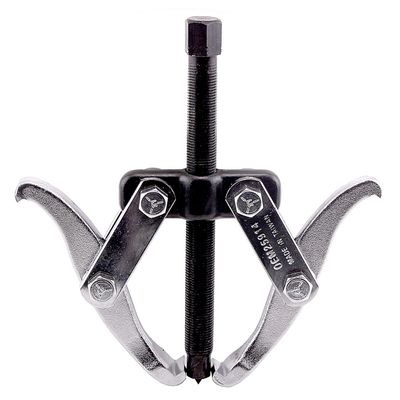
SO....I settled for a two-jaw puller, like this:


The firs time I tried, I just cranked down on the screw, like I've always done. After a few mighty cranks, it popped off the ball joint stud!

So I put it back on, cranked it down a bunch, and rapped the steering arm with a suitably large persuader, and the steering arm popped off.

Now to get the plastic pan, parts cleaning brush, and Gunk out so I can scrub all the grease off the parts. Then I'll regrease the ball joint with Mobil 1 synthetic grease (the red stuff), install the new dust cover/rubber boot, mount the steering arm back on the stud, torque the nut, install the cotter pin, and start reinstalling the left front suspension.

Putting it all back together, in my humble experience, usually goes faster than tearing it apart. Hopefully I'll have the left front back on the car by tomorrow afternoon, and then start in on the right side.

Pix to follow when reinstallation is complete.....

****UPDATE****

The steering arm is now scrubbed clean. As expected, I had to chop the bristles on the cleaning brush off about half-way. When cleaning caked on grease and dirt, you need pretty STIFF bristles to knock the crud off. Otherwise you'll just move it around on the part, rather than 'flicking' it off with the short, stiff bristles.

Another "Helpful Hint from The Doctor" is to scrape off as much of the solid stuff and big chunks as you can before you start applying the solvent and scrubbing the part. The cleaner the parts are before you start, the longer the solvent is good for before it becomes too loaded up with crud to do any cleaning, and the less time you'll spend hanging over a pan of solvent happily (?) scrubbing away.

Oh, and wear TWO pairs of nitrile gloves, as the parts invariably have some sharp edges, and when the gloves split, and they will, the second set will give you enough time to change them out before grease and dirt loaded solvent leaks into the gloves, and all over your hands. I've had pretty good luck with the 5-mil thick ones from Harbor Freight. The vinyl gloves they sell seem to split about two minutes after you put them on, but the nitrile ones are pretty tough, and reasonably priced. I see they also sell 7-mil and 9-mil thick ones, so when I go buy some more, I'll try the thicker ones.

This also reminds to add "washing up sink" to the items I'll want in the Colorado shop if we have to build one.

Back in the late 1970s, early 1980's when my buddy George and I ran the shop, we had a Safety-Kleen solvent-based parts washer in the shop. Since we were a low-volume place, the Safety-Kleen guy would only come around every couple of  months to check our solvent, and swap out the barrel of it that the machine sat on when it needed it. I don't remember how much it cost, but it was pretty reasonable, and that thing paid for itself many, many times over.

Now to work on the control arm........

****UPDATE 2**** 

Steering arm and lower control arm are now scrubbed "pretty damn clean". They both had 30+ years of grease, mud, oil, and other road grime caked on them that was 1/4 thick in places.

The ball joint was regreased with Mobil 1 synthetic grease after replacing the zerk fitting, which would no longer accept grease.

After watching the new grease come through the joint, I installed the new rubber boot/duct cover, as the old one was split from "Quick Change Grease Monkeys" pumping in WAY too much grease. Then I installed the now clean steering arm, torqued the nut to 58 ft-lbs, plus "a bit more" to get the castellations to line up with the cotter pin hole, and installed a new cotter pin.

I then added more grease until I saw the new rubber boot "inflate" slightly, at which point the fresh grease oozed out of the vent hole in the boot, and I stopped adding grease.

That, boys and girls, is how you properly grease a ball joint.....just until you see the rubber boot inflate slightly. And if you cleaned off the boot like you're supposed to before you started blindly pumping grease in to it, you'd also see the new grease ooze out of the vent hole, and then you'd STOP pumping grease in!

Sorry about this rant, but I've seen countless rubber dust boots on automotive steering linkages destroyed by excessive grease application, and there's no reason for it other than carelessness.

IF you always go back to the same grease pit on a regular basis, then you're probably OK, because the fresh grease pumped in every 6 months or so will keep the dirt that gets past the split boot from getting into the ball joint and wearing it out.

If you don't, then dirt gets in, the ball joint rapidly wears out, and your steering gets all sloppy and unsafe.

This probably all moot, as I don't think many (probably "any") new vehicles even have grease fittings on them any more.

ANYWHO......I'm sweaty, greasy, oily, and stink like kerosene from spraying and brushing Gunk on parts all afternoon.

BUT.....all the parts are now refurbished, CLEAN, and ready to go back together Monday morning.

Here's the completed Lower Control Arm. The "Steering Arm" is on the left, the new polyurethane bushing is on the right, and the loooong rod sticking out is the Strut Rod that had the "tatered-up" thread at the very end.


Compared to the assembly when it was still in the car:


I'm sure the guy who'll be doing the front end alignment will be happy to have nice, clean parts to adjust!

Fleet Week L.A. Coming Up

Was on the Iowa all day to help conduct some VIP tours of the radio areas and the CEC.

Had good, steady crowds all day, and they were setting up for some kind of "Bacon and Beer" festival tonight.

The "Bacon Nation" food truck was there, along with a couple of others, and the people handling the beer concession brought in THREE trucks of kegs of specialty brews from the local brewers.

The shore power installation is 99% finished, and there's talk they might cut over, and get OFF the generator, on Monday.

Finished up the day with a one hour presentation on the state of "drones" in various areas of aerial and undersea use.

Pretty good talk by my friend and radio compadre "Mr. Z".

More HERE at the PBC website.

I'm beat, and have to get back to work on the Supra Sunday. Left front suspension is 99.9% finished, and ready to go back in the car. Hopefully the right front wont take me THREE WEEKS to rebuild now that I have all the proper tools, and learned a whole bunch from the left side!

Saturday, August 27, 2016

RATS! Gotta Make ANOTHER Tool Run

Doggone it.....my tie rod end puller wasn't big enough to get the steering arm loose from the ball joint stud, so I ran out to O'Reilly's to get their "Pitman Arm" puller.

You guessed it......it's not big enough to slip over the steering arm and center on the ball joint stud.

So, as much as I HATE going to AutoZone, I'll stop there Saturday on my way home from the Iowa.

Thursday, August 25, 2016

Still Here, Still Gettin' Greasy!

Just been busy.

I boogered up the threads on the end of the Strut Control Rod by improperly removing it (long story...), so I had to get some BIG metric taps and dies to clean up the external threads on the rod, and the internal threads in the nut.

Would have greatly preferred to use "Rethreading" taps and dies, as they remove less metal, but the "repair" came out OK, and the nut still has an acceptable level of "looseness" to the way it fits.

And I'll use some BLUE Loctite on it when I reassemble it!

*****UPDATE***** 

Got this done after I made the post....

Old control arm bushing is pressed out, and the new Energy Suspension bushing is pressed in.

Used a combination of long bolts, nuts, washers, and a couple of sockets to press it out. Pressed the new polyurethane bushing in with a big "C" clamp and my bench vise, and then got the inner metal sleeve centered with the same long bolt and nuts I used to press the old one out.

The ball joint checks out OK...NO play at all in it. I'll clean as much of the old grease (which is clean) out of it as I can, replace the rubber boot which is split, and relube it with Mobil 1 synthetic grease. Then I can put the lower control arm and strut back in, and be DONE with the driver's side of the car!

Friday, August 19, 2016

Failed / Worn Out Parts

I my other post about Ms. Swan I mentioned that the top strut mounts were cracked "scary bad".

This is what I meant:


As you can see, this crack runs about 180* around the rubber, and if you look at it from a different angle, you can see the reinforcing fabric in the rubber.

The rubber parts on the sway bar end links were worse than this. The rubber parts fell apart as I was taking them out, and the cushions that mount the bar to the chassis were equally bad.

These were the original parts the car was "born" with, and I think it's a testament to the design and manufacturing quality that the Toyota Engineers put into them that they lasted 30+ years, and 167,000 miles.

The last time I did a complete front end rebuild like this was in about 1979 or so, when I did it to my 1975 Volkswagen Scirocco.

That car was only 4 years old, and the parts looked this bad.

Almost everything on the driver's side of the front suspension has now been rebuilt or replaced. The last thing I have to do is to replace the lower control arm bushing and the ball joint, and then start putting it all back together.

The nice thing about putting it back together is that everything is CLEAN! 


Which reminds me.....I really NEED to buy a Parts Washer!

Wednesday, August 17, 2016

Ms. Swan's Front End Rebuild....

OK, here's what I've been doing.....

Here's the car up on jacks with the left front strut removed. She should be in the garage, BUT, my wife has started "staging" things to get rid of before we move to Colorado, and the garage has become loaded with "junque" again.


 And here's the rest of the left front, with a bunch of worn out parts in evidence.


 And to remove the BIG nuts on the struts, I bought a BIG wrench at Harbor Freight. My wife calls this my "Clown Wrench" because it's so big (to her) that it "doesn't look real".

When I removed the nut, I clamped the strut in the vise, got ready to give a mighty grunt, and the nut came loose with hardy any pull at all!

The wrench came in handy to tighten the new nut, though....


 The top strut mount was toast, as seen by this "bottom view" of the bearing...


br />  Don't know if you can see the cracks in the rubber on the top, but when the car was sitting with the weight on the suspension, they were scary big....


 Here's the junky old Monroe "Sensatrac" insert. When the spring was off, I grabbed the rod and gave it a pull. It had about a HALF INCH of free play both ways before you could feel anything, and it gurgled when you cycled it.

TOTALLY shot.....


 Here's the OEM front spring on the right, along with the new Dobinsons #C59-070 that I bought from George at Raptor Racing. The wire diameter on the OEM spring is .550" / 14mm, and the free overall length is about 13.8" / 350mm.


 Here's another view of the springs. The wire diameter on the new Dobinsons C59-070 spring is .603" / 15.3mm, and the free overall length is about 11" / 280mm.


 And for those that might care (the American Iron guys go nuts for this type of information!), there was a violet paint stripe / color code on the OEM spring.


And here's the end result. A nice new shiny spring, new protective boot for the shock rod, and a new top strut mount.

Don't freak out about it being clamped in the vise jaws. It's barely tightened down to hold it for the photo, and when I did have it clamped down tight so I could torque the nut at the top of the new strut to 40 ft-lbs, I had two pieces of hardwood in there to cushion it so the jaws wouldn't bite into the new spring, possibly inducing stress fractures and weakening it.

As they used to say in the old Heathkit manuals..."This completes the assembly of this unit"!


I'll get this one back in the car after I R&R the lower control arm and strut rod bushings and replace the rubber boot/bellows on the power steering rack. It's completely dry on this side, so that means the seals are OK, but a torn boot like that just bugs me, and since I have a new one, REPLACE IT, JIM!!!


Then all I have to do is wash, rinse, and repeat this on the passenger side, and the front end is finished for now.


I blew off going down to the Iowa today as I'm on a roll here, and if I keep going I can have both sides of the front finished by Monday or Tuesday.


I learned a couple of tips and tricks from the guys on the Celica Supra forum, and I now have a couple of tools that make the job  much easier, along with a huge assortment of Cotter Pins that Ill need to bolt everything back together.


I have a pair of brand new lower control arms with OEM bushings and new ball joints, so I might just swap out the new bushings for the Energy Suspension PolyGraphite ones I have, rather than spend the extra time to change out the ball joints in the lower control arms that are on the car.


At the pace I work at, that would probably save a whole day.......


So stay tuned for another exciting episode of "The Continuing Adventures of Dr. Jim and Ms. Swan"!


Not quite as much fun as Doctor Who and his companions, but a whole lot more real.....


Monday, August 15, 2016

"Driving Ms. Swan", the Continuing Story....

Well, I've been banging away on my 1985 Supra in preparation for the "Supras in Vegas" show in September.

Got the gearbox oil changed, and my "Short Throw Shifter" installed.

No, it's not the "snick-snick" you'd get from a Hurst Competition PLUS shifter, but it's light years ahead of the one that was in the car. Part of the installation was the removal of a totally worn out metal/rubber/metal bushing in the shift rod inside the transmission, and replacing it with a bronze "Oilite" bushing kit made by one of the Celica Supra forum members. This change, along with replacing the plastic bushing on the bottom of the ball that engages it with a superior grade Delrin plastic, and the new shifter, made a tremendous improvement.

Today I pulled the driver's side strut/spring assembly out so I can replace the top strut mount plate, shock absorber insert, and install the new front spring that drops the car about 3/4".

I was planning on replacing a lot of other parts, and now after evaluating the general state of the suspension, it looks like I'll be replacing a few other things. I already have the parts, so rather than pulling it all apart later, I'll just do it now, as I have all the PROPER tools to do the job.

The top strut mount plate was full of cracks and splits, and looked pretty scary from the top. After removing it, I spent some time checking it, and some of the cracks go all the way through the rubber. The bearing was also very gritty and rough feeling, and all the grease was dried up. It's lasted 30 years and 167,000 miles, so I think it's due for retirement!

The lower control arm bushings have some nasty cracks in them, and the rubber boot over the ball joint is split allowing all the grease to come oozing out. Since I have these parts on hand, they'll be changed.

The flexible hose to the brake caliper was in worse condition than I expected. The outer jacket was peeled away in several places, revealing the fabric reinforcement inside the hose, so that definitely has to go! I have a full set, front and rear, of stainless steel braided lines that I'll be using as replacements. I've used these before on other cars, and besides being very sturdy, they also give a better pedal feel due to the fact that they don't expand when you hit the brakes.

The pads in the caliper looked almost new, as well as the rotor, but they're being replaced as well. The rotors are StopTech "Sport Rotors", drilled for cooling, and the pads are high-performance ceramic "street" pads. And the brake system will get a flush and fluid replacement with DOT4 fluid.

And one surprise was the rubber boot for the tie rod arm that comes out of the steering rack. It's split, also, like the one I already knew about on the passenger side!

Again, I ordered two boots, so those will be swapped out.

And I'll be scrubbing off all the accumulated grease/gunk/road grime, and hitting any bare metal with a shot of paint.

Wednesday, August 10, 2016

Godspeed, Mike.......

I'd write something poignant, but I'm not, and never will be, good enough to eulogize Mike....

Godspeed, Mike, and God Bless your family. Thanks for all you did.


Monday, August 8, 2016

HAARP to Reactivate in 2017


Oh, boy. The conspiracy nuts will have a field day (no pun intended) over this one.

Courtesy of the ARRL:

Let the conspiracy theories resume! Alaska’s High-Frequency Active Auroral Research Program (HAARP) facility will reopen in 2017. The sprawling facility now is under the ownership of the University of Alaska Fairbanks (UAF), and the UAF Geophysical Institute is preparing HAARP for a new sponsored research campaign that’s set to begin early next year, UAF Researcher Chris Fallen, KL3WX, told ARRL.
“This involves, for example, reinstalling the vacuum tubes in each of the 10 kW amplifiers — eventually 360 in total — that were removed by the US Air Force [the facility’s former owner] for warm storage in the main facility,” Fallen said. He noted that the transmitter shelters have been unheated since the previous campaign in the summer of 2014. “The five generators — approximately 3 MW each — have recently been tested individually and are verified operational.”
Fallen said the HAARP ionosonde (DPS4D “Digisonde”) will be brought back online. “Some instruments on site need to be repaired or replaced,” he said. Those would include riometers and a UHF radar. “Optical instruments will be brought back. The flux-gate magnetometer is operational again.”
Fallen said other researchers are planning to install instruments at the science pads. “We are still investigating models for increasing Amateur Radio involvement with HAARP, which, in addition to announcing operating schedules, can potentially include hosting one or more ham stations on or near the science pads,” he said.
UAF describes HAARP as “the world’s most capable high-power, high-frequency transmitter for study of the ionosphere.” Constructed in 1990 at a cost of some $300 million, HAARP over the years has inspired a wide range of conspiracy theories that became grist for late-night radio talk shows. Some have claimed that HAARP’s 3 GW transmitter and 30-acre antenna farm have been used to control the weather, while others have argued that HAARP has caused earthquakes.
The FCC recently granted two Part 5 Experimental Service licenses for HAARP ionospheric research “across multiple bands.” WI2XFX will cover experiments in discrete parts of the HF spectrum, including 2650-2850; 3155-3400; 4438-4650; 4750-4995; 5005-5450; 5730-5950, and 7300-8100 kHz. A second Experimental license, WI2XDV, covers ionospheric research between 1 and 40 MHz.
UAF is hosting an open house at HAARP, located near Gakona, Alaska, on August 27. The event will feature facility tours, a mobile planetarium, a permafrost exhibit, science demonstrations and talks, and barbecue.
Fallen will deliver a free science lecture on Friday, August 26, at the Wrangell-St Elias National Park Visitor Center Auditorium, “Radio Modification of the Ionosphere, and Who Uses This HAARP Thing Anyway?” in partnership with the Wrangell Institute for Science and the Environment (WISE)
HAARP is aimed at studying the properties and behavior of the ionosphere. Operation of the research facility was transferred from the US Air Force to the University of Alaska Fairbanks last August, allowing HAARP to continue exploring ionospheric phenomena via a land-use cooperative research and development agreement.

Tuesday, August 2, 2016

"Phase 1" Painting Finished

Living room and dining room areas are done, and put back together.

Kinda shot the "Working on my Supra all weekend" plans, but, sigh......

Not sure what the wife has planned next, but I'm sure it will be another "Big Deal".

Going to a meeting tonight of the Los Angeles Area Council of Amateur Radio Clubs, which is an organization composed of all the Ham Radio clubs in the area. I'm the rep for the Battleship Iowa Amateur Radio Association, so I get to go to attempt to keep BIARA informed of future plans.

LAACARC is the group that puts on HAMCON in SoCal every few years. Since one of the clubs has backed out this year, we'll be hosting it again at the end of 2017. I'm planning on being out of here by then, but I'll help right up until we move.

SLW's BFF Passes Quietly

 On Friday, the 29th, and 1215pm local time. Surrounded by family and friends, and her two dogs. Things have been a bit hectic here, as expe...