Because I started this morning with two empty trash bins, one for "recyclable" stuff, and one for everything else.
The recycle bin is already about half full of cut-up, smashed flat cardboard boxes and misc packing material, and the regular trash bin is about one-quarter full.
I'm taking the advice of one of my friends over on the Celica Supra forum; drag it all out, sort it, and then rearrange it as you put it back in.
So far, I've found another Heathkit receiver (a GR-78) I bought and forgot about, a Commodore 1571 disk drive with cables, two Commodore power supplies, both new-in-box, all the cables I've made over the years to connect various radios I've owned and still own to both an AEA Commodore Packet Radio modem, and my Kantronics KPC-3+, and several more boxes containing all the leftover stuff that you never use, but they include in the box a new PC motherboard comes in.
At least I can now have the big door open, and walk from there to the front of the garage, so it's a big improvement.
My current SWAG is that I'm about 21% to where I need to be.
And I haven't gotten to the workbench area, and the shelving along the walls....
Gonna be a long, slow, slog........
Monday, February 22, 2016


Sunday, February 21, 2016
The Never Ending Garage Clean Up Continues.......
Man, I should have done this two years ago when I bought the car. Then you'd be reading my gripes about me actually working on the car vs getting the damn garage cleaned out.
Made a pretty big dent the last couple of days. At this point I'll take a SWAG and say I'm 20% to where I need to be.
I'm glad tomorrow is trash day, as I've completely filled (packed pretty tight, too) the "Recycle" bin with empty, flattened out cardboard boxes, and misc bits and pieces of "stuff" that are allowed in that bin, and the regular bin that gets everything else.
I finally got my two Dahlquist DQM-9 speakers out of there. They'll be going on the back porch for now until I get them listed onweirdoslist craigslist for sale.
If anybody "local" is interested in them, drop me a line and we'll talk. I got them from a very good friend who takes fanatical care of his equipment. He just had new foam edge surrounds (outer edge of the cones) installed by Dahlquist right before I bought them, and the cabinets look like new.
And I consolidated about 10~12 other boxes of small items (mostly computer stuff) into three boxes, meaning there's a lot less wasted space.
I still don't know what I'm going to do with all the PC bits and pieces I have; perhaps just sell them in "lots" on eBay. Stuff like that I won't list onweirdoslist craigslist because of previous bad experiences selling computer stuff there. Every single person who came to look at the stuff I had wanted to offer me me pennies on the dollar for brand-new parts and completely rebuilt and upgraded PC's.
I know what the "retail" value of the stuff is, and offering me $20 for something easily worth $200 is an insult. The $200 price I had on things was well under "retail", and even the flippers that came to look at it knew that, yet insisted on low-balling me to the extreme.
Oh, well....dinner time here, and then back out to the other end of the garage. At least I have free access to my two big rolling tool boxes now, and I can get to the shelving units behind them, and start going through all that stuff..........
Made a pretty big dent the last couple of days. At this point I'll take a SWAG and say I'm 20% to where I need to be.
I'm glad tomorrow is trash day, as I've completely filled (packed pretty tight, too) the "Recycle" bin with empty, flattened out cardboard boxes, and misc bits and pieces of "stuff" that are allowed in that bin, and the regular bin that gets everything else.
I finally got my two Dahlquist DQM-9 speakers out of there. They'll be going on the back porch for now until I get them listed on
If anybody "local" is interested in them, drop me a line and we'll talk. I got them from a very good friend who takes fanatical care of his equipment. He just had new foam edge surrounds (outer edge of the cones) installed by Dahlquist right before I bought them, and the cabinets look like new.
And I consolidated about 10~12 other boxes of small items (mostly computer stuff) into three boxes, meaning there's a lot less wasted space.
I still don't know what I'm going to do with all the PC bits and pieces I have; perhaps just sell them in "lots" on eBay. Stuff like that I won't list on
I know what the "retail" value of the stuff is, and offering me $20 for something easily worth $200 is an insult. The $200 price I had on things was well under "retail", and even the flippers that came to look at it knew that, yet insisted on low-balling me to the extreme.
Oh, well....dinner time here, and then back out to the other end of the garage. At least I have free access to my two big rolling tool boxes now, and I can get to the shelving units behind them, and start going through all that stuff..........
Saturday, February 20, 2016
Minuteman III Launch Tonight From VAFB
From one of my groups.........
The following is a media advisory from Vandenberg AFB:
FOR IMMEDIATE RELEASE
From: 30th Space Wing Public Affairs, www.vandenberg.af.mil
MINUTEMAN III LAUNCH SCHEDULED
VANDENBERG AIR FORCE BASE, Calif. - - An operational test launch of an Air Force Global Strike Command unarmed Minuteman III intercontinental ballistic missile is scheduled between 11:00 p.m. PST Saturday, Feb. 20 and 5:00 a.m. PST Sunday, Feb. 21, 2016, from north Vandenberg Air Force Base.
The purpose of the ICBM test launch program is to validate and verify the effectiveness, readiness and accuracy of the weapon system, according to Air Force Global Strike Command.
Col. J. Christopher Moss, 30th Space Wing commander, is the launch decision authority.
"This mission continues a long string of vital ICBM flight tests from
Vandenberg Air Force Base," said Moss. "The launch not only demonstrates the capability of the Minuteman III weapon system, but also the tremendous capabilities of Airmen who maintain and operate it. The men and women of the 30th Space Wing are proud to partner with the Air Force Global Strike Command team to conduct this important launch."
The launch team, under the direction of the 576th Flight Test Squadron,
includes aircrew members from the 625th Strategic Operations Squadron, Offutt AFB, Nebraska, and crew members and maintainers from the 91st Missile Wing, Minot AFB, North Dakota.
The 576th FLTS is responsible for installed tracking, telemetry and command destruct systems on the missile, which collect data and ensure safety requirements, are met.
If you're out here on the Left Coast, and have the time to sit and just watch for a few hours, these are spectacular to see.
The following is a media advisory from Vandenberg AFB:
FOR IMMEDIATE RELEASE
From: 30th Space Wing Public Affairs, www.vandenberg.af.mil
MINUTEMAN III LAUNCH SCHEDULED
VANDENBERG AIR FORCE BASE, Calif. - - An operational test launch of an Air Force Global Strike Command unarmed Minuteman III intercontinental ballistic missile is scheduled between 11:00 p.m. PST Saturday, Feb. 20 and 5:00 a.m. PST Sunday, Feb. 21, 2016, from north Vandenberg Air Force Base.
The purpose of the ICBM test launch program is to validate and verify the effectiveness, readiness and accuracy of the weapon system, according to Air Force Global Strike Command.
Col. J. Christopher Moss, 30th Space Wing commander, is the launch decision authority.
"This mission continues a long string of vital ICBM flight tests from
Vandenberg Air Force Base," said Moss. "The launch not only demonstrates the capability of the Minuteman III weapon system, but also the tremendous capabilities of Airmen who maintain and operate it. The men and women of the 30th Space Wing are proud to partner with the Air Force Global Strike Command team to conduct this important launch."
The launch team, under the direction of the 576th Flight Test Squadron,
includes aircrew members from the 625th Strategic Operations Squadron, Offutt AFB, Nebraska, and crew members and maintainers from the 91st Missile Wing, Minot AFB, North Dakota.
The 576th FLTS is responsible for installed tracking, telemetry and command destruct systems on the missile, which collect data and ensure safety requirements, are met.
If you're out here on the Left Coast, and have the time to sit and just watch for a few hours, these are spectacular to see.
Thursday, February 18, 2016
Rainy Wednesday/Thursday and Garage Cleaning
We need the rain, and I like sleeping when it's raining.
Got around half an inch, and the temperature dropped 10 degrees or so.
Dried out today, but a bit chilly (for Kaliforniastan!), so wearing a jacket while I'm going through boxes of stuff in the garage that haven't seen the light of day in quite a while.
Man, I didn't know I had so much stuff for repairing PC's!
I've got 30+ cooling fans of various sizes used to replace faulty power supply, CPU, and case fans, 30 or more Intel PCI 10/100Base-T Ethernet cards (remember when motherboards did NOT come with built-in Ethernet?), half a dozen or so sound cards, and a wide selection of video cards, with interfaces running the gamut from PCI to AGP, to PCIe, four 500 Watt "AT" power supplies, and all of this stuff is brand new.
I even have a few brand new 5-1/4" floppy drives, along with a good sized stack of 3-1/2" floppy drives.
And BOXES of memory going back to pre SDRAM stuff like "EDO" memory.
Don't have too many processors, except ones that were in the few motherboards I have. Mostly AMD K6 processors, as I was really hot into the "Socket 7" and "Super Socket 7" stuff.
The "rarest" processor I have would be a K6-III+ with a rated clock speed of 550 MHz. Not too many of those were released, and I'm not sure how I got it.
I suppose if I hang on to this stuff the price will go up, but for now, it's just a huge collection of memories from early days of building, repairing, and modifying PC's.......
Got around half an inch, and the temperature dropped 10 degrees or so.
Dried out today, but a bit chilly (for Kaliforniastan!), so wearing a jacket while I'm going through boxes of stuff in the garage that haven't seen the light of day in quite a while.
Man, I didn't know I had so much stuff for repairing PC's!
I've got 30+ cooling fans of various sizes used to replace faulty power supply, CPU, and case fans, 30 or more Intel PCI 10/100Base-T Ethernet cards (remember when motherboards did NOT come with built-in Ethernet?), half a dozen or so sound cards, and a wide selection of video cards, with interfaces running the gamut from PCI to AGP, to PCIe, four 500 Watt "AT" power supplies, and all of this stuff is brand new.
I even have a few brand new 5-1/4" floppy drives, along with a good sized stack of 3-1/2" floppy drives.
And BOXES of memory going back to pre SDRAM stuff like "EDO" memory.
Don't have too many processors, except ones that were in the few motherboards I have. Mostly AMD K6 processors, as I was really hot into the "Socket 7" and "Super Socket 7" stuff.
The "rarest" processor I have would be a K6-III+ with a rated clock speed of 550 MHz. Not too many of those were released, and I'm not sure how I got it.
I suppose if I hang on to this stuff the price will go up, but for now, it's just a huge collection of memories from early days of building, repairing, and modifying PC's.......
Wednesday, February 17, 2016
Iowa Transmitters NOT On-The-Air Today. Next Post About This Will Occur When We're Actually OTA.....
This is getting frustrating, but I won't vent here.
Next time I post about this will be when I'm on-the-air!
PERIOD.......
Next time I post about this will be when I'm on-the-air!
PERIOD.......
Tuesday, February 16, 2016
OK, Let's Try This Again...Battleship Iowa's 1980's Transmitters to be ON-THE-AIR Wednesday 17 Feb 16
Well....I'm pretty sure I've got everybody on the same page for this.
We'll either be on 20 Meters around 14.261 or 17 Meters around 18.161, +/- any QRM.
All the equipment is working, I'm going to be giving the guys in the Gray Radio Gang some training in "Good Amateur Operating Practice" (most of them don't have stations at home), and then we should get OTA shortly after lunch, around 1300 local time, until about 1600, or 2100 UTC to 0000 UTC.
If you hear us, please bear with us. We won't be using the NI6BB callsign, but we will announce that we're operating from the Battleship Iowa.
I'm taking my tablet, and if I can get the damn Blogger software to cooperate, I'll post here that we're on, and we'll also self spot ourselves on the DX clusters.
Keep your fingers crossed!
We'll either be on 20 Meters around 14.261 or 17 Meters around 18.161, +/- any QRM.
All the equipment is working, I'm going to be giving the guys in the Gray Radio Gang some training in "Good Amateur Operating Practice" (most of them don't have stations at home), and then we should get OTA shortly after lunch, around 1300 local time, until about 1600, or 2100 UTC to 0000 UTC.
If you hear us, please bear with us. We won't be using the NI6BB callsign, but we will announce that we're operating from the Battleship Iowa.
I'm taking my tablet, and if I can get the damn Blogger software to cooperate, I'll post here that we're on, and we'll also self spot ourselves on the DX clusters.
Keep your fingers crossed!
Sunday, February 14, 2016
Been Busy Tinkering on the Supra
"Supras In Vegas" is coming again this year, and I plan to have the car ready to go.
It's the 3rd week in September, which gives me about seven months to:
Replace the carpet, install the new stereo and speakers, and put the interior back together. I'll do a good cleaning of the floor under the old carpet, as I'm sure there's a ton of crud under the old carpet. While the front seats are out it will also give me access to the bracket that holds the levers for opening the rear hatch and gas filler door so I can bolt it back to the floor pan. It's currently adrift, and makes it a PITA to use.
Rebuild the front suspension with new KYB strut inserts, top strut mounts, springs that lower the car about 1", rebuilt power steering rack and pinion, new polyurethane bushings, and new rotors/calipers/wheel bearings. The new rotors are the drilled/slotted type, and are supposed to run cooler. One of the things Car and Driver noticed in their long-term test back in 1983 was that the rotors had a tendency to warp, so hopefully 30+ years of advances in rotor metallurgy and brake pad compounds will prevent that from occurring. I'm replacing the OEM rubber brake lines with stainless steel brake lines, and I'll flush and refill the brake system with "DOT 4" brake fluid. While I'm under the car I'll also replace the clutch slave cylinder, replace the OEM rubber clutch hydraulic line with a stainless one, and flush and refill the system with "DOT 4" fluid. The clutch master cylinder was replaced shortly before I bought the car, and the fluid is still "clear", so the master cylinder can stay for now.
Replace the cam drive belt and idler, and the water pump while the front is off the engine. Also replace all the coolant hoses and A/C, alternator drive belts. There's a hose that runs under the intake manifold/air plenum that needs to be replaced on a somewhat regular interval. It's called the "suicide hose", because if it blows, you've got about 60 seconds to shut the engine down before it overheats, usually blowing the head gasket in the process. If all it does is blow the head gasket you can consider yourself lucky. If you keep going, the head will warp, and replacement heads for this engine have been "unobtainium" for some years now.
Replace the rear shocks with new KYB shocks, replace the springs with new ones that lower the car about 3/4", and replace the upper and lower spring mounts (aka "the rubbers"). Also replace the rotors and calipers and OEM brake hoses with stainless steel ones.
And to help matters along, I just returned from Home Depot with some new light fixtures, and a box of bulbs.
I *had* a couple of cheep two-bulb, 48" lights hanging, but when the kids moved out, one of them mysteriously disappeared. I found another one in the garage, but it doesn't have an ON/OFF pull chain, so it will probably go in the scrap pile.
The new lights hanging off to the sides of the car are four-bulb 48" fixtures, and I bought a new 48" high-brightness LED fixture for hanging over the workbench.
The original two-bulb fixtures will be relocated to the rear (toward the big door) of the garage so I can get some light back there.
And of course, I'm back to cleaning the garage (again!) because of all the cruft my wife has "stored" in there.
How come MY stuff is always "junk that should be thrown away", but HER stuff is "Ohhh...we have to keep that!"??
AND finally, we're really going to try and get the Iowa's radio gear on-the-air this coming Wednesday.
I'll take my tablet and post from the ship if we mange to get everybody on the same page to do this.
For those that have asked, here's the original post from when I brought the Supra home:
http://every-blade-of-grass.blogspot.com/2014/01/new-project-for-new-year.html
It's the 3rd week in September, which gives me about seven months to:
Replace the carpet, install the new stereo and speakers, and put the interior back together. I'll do a good cleaning of the floor under the old carpet, as I'm sure there's a ton of crud under the old carpet. While the front seats are out it will also give me access to the bracket that holds the levers for opening the rear hatch and gas filler door so I can bolt it back to the floor pan. It's currently adrift, and makes it a PITA to use.
Rebuild the front suspension with new KYB strut inserts, top strut mounts, springs that lower the car about 1", rebuilt power steering rack and pinion, new polyurethane bushings, and new rotors/calipers/wheel bearings. The new rotors are the drilled/slotted type, and are supposed to run cooler. One of the things Car and Driver noticed in their long-term test back in 1983 was that the rotors had a tendency to warp, so hopefully 30+ years of advances in rotor metallurgy and brake pad compounds will prevent that from occurring. I'm replacing the OEM rubber brake lines with stainless steel brake lines, and I'll flush and refill the brake system with "DOT 4" brake fluid. While I'm under the car I'll also replace the clutch slave cylinder, replace the OEM rubber clutch hydraulic line with a stainless one, and flush and refill the system with "DOT 4" fluid. The clutch master cylinder was replaced shortly before I bought the car, and the fluid is still "clear", so the master cylinder can stay for now.
Replace the cam drive belt and idler, and the water pump while the front is off the engine. Also replace all the coolant hoses and A/C, alternator drive belts. There's a hose that runs under the intake manifold/air plenum that needs to be replaced on a somewhat regular interval. It's called the "suicide hose", because if it blows, you've got about 60 seconds to shut the engine down before it overheats, usually blowing the head gasket in the process. If all it does is blow the head gasket you can consider yourself lucky. If you keep going, the head will warp, and replacement heads for this engine have been "unobtainium" for some years now.
Replace the rear shocks with new KYB shocks, replace the springs with new ones that lower the car about 3/4", and replace the upper and lower spring mounts (aka "the rubbers"). Also replace the rotors and calipers and OEM brake hoses with stainless steel ones.
And to help matters along, I just returned from Home Depot with some new light fixtures, and a box of bulbs.
I *had* a couple of cheep two-bulb, 48" lights hanging, but when the kids moved out, one of them mysteriously disappeared. I found another one in the garage, but it doesn't have an ON/OFF pull chain, so it will probably go in the scrap pile.
The new lights hanging off to the sides of the car are four-bulb 48" fixtures, and I bought a new 48" high-brightness LED fixture for hanging over the workbench.
The original two-bulb fixtures will be relocated to the rear (toward the big door) of the garage so I can get some light back there.
And of course, I'm back to cleaning the garage (again!) because of all the cruft my wife has "stored" in there.
How come MY stuff is always "junk that should be thrown away", but HER stuff is "Ohhh...we have to keep that!"??
AND finally, we're really going to try and get the Iowa's radio gear on-the-air this coming Wednesday.
I'll take my tablet and post from the ship if we mange to get everybody on the same page to do this.
For those that have asked, here's the original post from when I brought the Supra home:
http://every-blade-of-grass.blogspot.com/2014/01/new-project-for-new-year.html
Wednesday, February 10, 2016
Iowa Transmitters NOT On-The-Air Today. Next Week for Sure!
WELL......I got down to the ship today, and the guys had veered off onto a different path.
They decided they wanted to work on the autocoupler for the port side 30 foot whip, rather than get the gear OTA today.
Oh, well....not wanting to herd cats, I stepped back and did some other things.......
They decided they wanted to work on the autocoupler for the port side 30 foot whip, rather than get the gear OTA today.
Oh, well....not wanting to herd cats, I stepped back and did some other things.......
Sunday, February 7, 2016
Battleship Iowa's "Original" 1980's Transmitters Possibly ON-THE-AIR This Coming Wednesday!
WELL....it's been a long, slow, slog, but we're 90+% there.
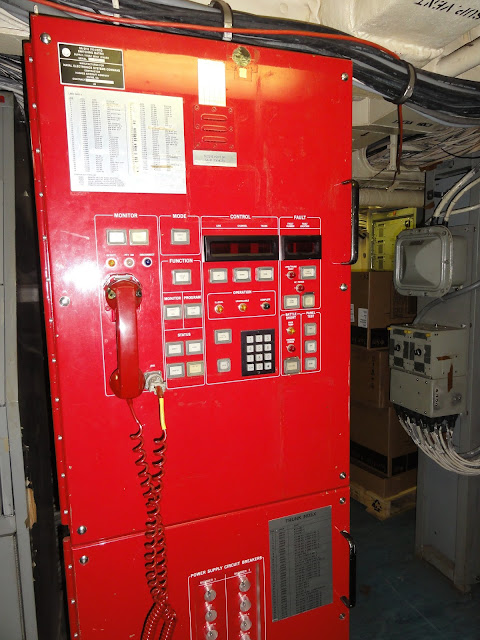
We have two "Red Phones" mapped out through the "Coke Machine", the audio interface boxes, the transmit and receive switchboards, and the R-1051 receivers and the AN/URT-23A transmitters.
We've verified that we have correct receive audio through the receive path, and the transmit audio from the "Red Phones" also makes it down to the Transmitter Room, and drive the #3 transmitter to full (1000 Watts +) power into a dummy load.
For the receive antennas we're using the "Twin Whips" mounted up on the bridge, and for transmit, we'll be using the "Goal Post" or "Bull's Horns" antenna located just forward of the #2 stack. The "Goal Post" antenna is fed with (I think) 3-1/2" Heliax cable from the transmitter room, and some time ago I made up an adapter that connected the Andrew flange to a Type-N female so we could run coax into one of the large antenna couplers down in the transmit room.
I used my Comet CAA-500 Antenna Analyzer to verify that adjusting the controls on the coupler caused the impedance to vary, and the manner in which it varied it varied in "looked" just like we were tuning a random length antenna with a good old Johnson Matchbox.
The players are as follows:
A "Red Phone":

The Infamous "Coke Machine":
R-1051 Receiver:

Receive Antenna Couplers:

"Twin Whips" Receive Antennas:

AN/URT-23 Transmitter:

Transmit Antenna Coupler(s):

"Goal Post" Transmit Antenna:

I'm posting this early so those who are interested in trying work us will have plenty of time to get ready. We know we transmit better than we receive, even running 100 Watts from the Amateur Radio gear, so please be patient with us if we manage to make this happen.
Not all of us are "Contest Operators", so pile-ups will be dealt with "Loudest Heard First", and then we'll try to get to the weaker stations.
Look for us in the upper half of the General section of the 20 Meter phone band. *IF* we get the gear On-The-Air, it will be after 2000 UTC, and before 2359 UTC.
We'll be using an individual's callsign, not NI6BB, and we'll include "Battleship Iowa" in all our CQ's.
Hope to see you On The Air!
I'll have my tablet computer with me, so if this is a "GO!", I'll make a post here right before we go live OTA.
We have two "Red Phones" mapped out through the "Coke Machine", the audio interface boxes, the transmit and receive switchboards, and the R-1051 receivers and the AN/URT-23A transmitters.
We've verified that we have correct receive audio through the receive path, and the transmit audio from the "Red Phones" also makes it down to the Transmitter Room, and drive the #3 transmitter to full (1000 Watts +) power into a dummy load.
For the receive antennas we're using the "Twin Whips" mounted up on the bridge, and for transmit, we'll be using the "Goal Post" or "Bull's Horns" antenna located just forward of the #2 stack. The "Goal Post" antenna is fed with (I think) 3-1/2" Heliax cable from the transmitter room, and some time ago I made up an adapter that connected the Andrew flange to a Type-N female so we could run coax into one of the large antenna couplers down in the transmit room.
I used my Comet CAA-500 Antenna Analyzer to verify that adjusting the controls on the coupler caused the impedance to vary, and the manner in which it varied it varied in "looked" just like we were tuning a random length antenna with a good old Johnson Matchbox.
The players are as follows:
A "Red Phone":

The Infamous "Coke Machine":

R-1051 Receiver:

Receive Antenna Couplers:

"Twin Whips" Receive Antennas:

AN/URT-23 Transmitter:

Transmit Antenna Coupler(s):

"Goal Post" Transmit Antenna:

I'm posting this early so those who are interested in trying work us will have plenty of time to get ready. We know we transmit better than we receive, even running 100 Watts from the Amateur Radio gear, so please be patient with us if we manage to make this happen.
Not all of us are "Contest Operators", so pile-ups will be dealt with "Loudest Heard First", and then we'll try to get to the weaker stations.
Look for us in the upper half of the General section of the 20 Meter phone band. *IF* we get the gear On-The-Air, it will be after 2000 UTC, and before 2359 UTC.
We'll be using an individual's callsign, not NI6BB, and we'll include "Battleship Iowa" in all our CQ's.
Hope to see you On The Air!
I'll have my tablet computer with me, so if this is a "GO!", I'll make a post here right before we go live OTA.
Friday, February 5, 2016
Out With The Old.......UPDATE
And in with the new.
Jeep radio, that is.
I finally received the "4-pin" data cable I needed to get the Maestro unit talking to my new Kenwood "head unit", and decided to take the plunge and do it today.
It's not 100% finished, but it's in the dash, all connected up, and everything works!
Had a nice chat with the rep from Sirius/XM, and we killed the OEM Sirius radio that came with the Jeep, activated the new one, went over the freebies that came with the new radio, and got everything squared away.
I still have to find the best place to stick down the microphone for the "hands free" Bluetooth operation of my cellphone, figure out how to run the cable from the new Sirius/XM antenna into the car, and figure out how to best run the female USB cable that lets me plug in a USB stick and play music and videos on the head unit.
And Kenwood has newer firmware for the head unit, so I have to reflash it, and I still have to sign up with Garmin so I can keep the maps updated for the nav.
After that, I'll just snap the bezels back on the instrument pod where the GPS antenna is located, and the bezel that covers the radio.
Then I have to learn how to use the doggone thing, program my favorite satellite radio channels, FM radio channels, and the couple of AM channels I use.
I stick a few pix on here tomorrow.
****UPDATE****
It took me until midnight last night but I finally got the receiver to accept the USB memory stick with the updated firmware.
The manuals are poorly written in regard to this, and assume you already know the menu structure of the radio.
They kept mentioning to "put the radio into standby", with no explanation of how to find the "standby" menu setting. The main menu button takes you to the "Top Menu", and there's three little bars at the top of the screen. In my experience this usually indicates there are a total of three pages to the menu. BUT...how to get to the next pages? The radio has a touch screen, so I tried dragging the screen to the left. No luck, and this stumped me for a while. I finally figured out that to get off the first page of the menu you have to "flick" the screen to the left at just the right rate to get it on the next page.
There was the "Standby" button, and once I pressed that button, the "upgrade" button on the screen displaying the installed firmware version was no longer greyed out, and I was able to upgrade the firmware from the memory stick.
The next thing was getting updated maps into the navigation section of the radio. Garmin requires you to dump an XML file onto an SD memory card, insert it into a Windows or Mac PC, and then use their web application to read the card, and confirm you have a qualifying product. Then, after you pay your $69.95 for the new maps, it will download and install the new map files onto the SD card. I had the same issue with the nav section of the receiver....it wouldn't dump the file onto the card unless the radio was in standby mode. About 2345 last night I had the XML file on the card, and was able to get the Garmin web app to accept it, and proceeded to install the "updated" maps on it, but I couldn't find out how to get the file loaded off the card and into the receiver.
This morning I was on the support section of the Garmin website, and finally found out that all you do is install the card in the slot, and it reads the new data from the card. I put the card in the slot, and upon hitting the "upgrade maps" from another obscure menu setting only accessible when in standby, I was rewarded with "Reading Updated Map Info" on the screen.
They don't tell you if it overwrites the existing data in the radio, or if it needs the card in all the time, so I just left it in the radio.
Since the map version was "2014.0", and the new map version is "2015.0", it looks like they don't upgrade the maps very often!
I stuck down the microphone for the hand-free cellphone function, and stuck the bezel back on that part of the dash. I still haven't figured out how I'm going to run the antenna lead-in cable for the new Sirius/XM tuner from the antenna into the car, and then into the under/behind dash area, but it looks like that will be a several hour job by itself, involving pulling a bunch of interior trim panels off, routing the cable, and then putting it all back together.
This radio definitely sounds better than the OEM Alpine radio it replaced, and I'm getting a bunch more satellite channels than I did before, as I upgraded my Sirius/XM subscription.
And the FM tuner not only has regular FM, but also "HD Radio", which lets the broadcasters either deliver higher-quality audio, or multiple channels, similar to what the new Digital TVs have. Where you only had "Channel 5" before, you now have sub-channels like 5.1, 5.2, etc.
Think I'm going to take the dog for a walk....I need to relax a bit, and "wind down" from this project!
Jeep radio, that is.
I finally received the "4-pin" data cable I needed to get the Maestro unit talking to my new Kenwood "head unit", and decided to take the plunge and do it today.
It's not 100% finished, but it's in the dash, all connected up, and everything works!
Had a nice chat with the rep from Sirius/XM, and we killed the OEM Sirius radio that came with the Jeep, activated the new one, went over the freebies that came with the new radio, and got everything squared away.
I still have to find the best place to stick down the microphone for the "hands free" Bluetooth operation of my cellphone, figure out how to run the cable from the new Sirius/XM antenna into the car, and figure out how to best run the female USB cable that lets me plug in a USB stick and play music and videos on the head unit.
And Kenwood has newer firmware for the head unit, so I have to reflash it, and I still have to sign up with Garmin so I can keep the maps updated for the nav.
After that, I'll just snap the bezels back on the instrument pod where the GPS antenna is located, and the bezel that covers the radio.
Then I have to learn how to use the doggone thing, program my favorite satellite radio channels, FM radio channels, and the couple of AM channels I use.
I stick a few pix on here tomorrow.
****UPDATE****
It took me until midnight last night but I finally got the receiver to accept the USB memory stick with the updated firmware.
The manuals are poorly written in regard to this, and assume you already know the menu structure of the radio.
They kept mentioning to "put the radio into standby", with no explanation of how to find the "standby" menu setting. The main menu button takes you to the "Top Menu", and there's three little bars at the top of the screen. In my experience this usually indicates there are a total of three pages to the menu. BUT...how to get to the next pages? The radio has a touch screen, so I tried dragging the screen to the left. No luck, and this stumped me for a while. I finally figured out that to get off the first page of the menu you have to "flick" the screen to the left at just the right rate to get it on the next page.
There was the "Standby" button, and once I pressed that button, the "upgrade" button on the screen displaying the installed firmware version was no longer greyed out, and I was able to upgrade the firmware from the memory stick.
The next thing was getting updated maps into the navigation section of the radio. Garmin requires you to dump an XML file onto an SD memory card, insert it into a Windows or Mac PC, and then use their web application to read the card, and confirm you have a qualifying product. Then, after you pay your $69.95 for the new maps, it will download and install the new map files onto the SD card. I had the same issue with the nav section of the receiver....it wouldn't dump the file onto the card unless the radio was in standby mode. About 2345 last night I had the XML file on the card, and was able to get the Garmin web app to accept it, and proceeded to install the "updated" maps on it, but I couldn't find out how to get the file loaded off the card and into the receiver.
This morning I was on the support section of the Garmin website, and finally found out that all you do is install the card in the slot, and it reads the new data from the card. I put the card in the slot, and upon hitting the "upgrade maps" from another obscure menu setting only accessible when in standby, I was rewarded with "Reading Updated Map Info" on the screen.
They don't tell you if it overwrites the existing data in the radio, or if it needs the card in all the time, so I just left it in the radio.
Since the map version was "2014.0", and the new map version is "2015.0", it looks like they don't upgrade the maps very often!
I stuck down the microphone for the hand-free cellphone function, and stuck the bezel back on that part of the dash. I still haven't figured out how I'm going to run the antenna lead-in cable for the new Sirius/XM tuner from the antenna into the car, and then into the under/behind dash area, but it looks like that will be a several hour job by itself, involving pulling a bunch of interior trim panels off, routing the cable, and then putting it all back together.
This radio definitely sounds better than the OEM Alpine radio it replaced, and I'm getting a bunch more satellite channels than I did before, as I upgraded my Sirius/XM subscription.
And the FM tuner not only has regular FM, but also "HD Radio", which lets the broadcasters either deliver higher-quality audio, or multiple channels, similar to what the new Digital TVs have. Where you only had "Channel 5" before, you now have sub-channels like 5.1, 5.2, etc.
Think I'm going to take the dog for a walk....I need to relax a bit, and "wind down" from this project!
Tuesday, February 2, 2016
Running a Tube-Type Radio on "Car Batteries" - PART 1-
This was starting to get a bit looong, so I'm splitting it into two parts...
I also made a few changes so "Part 2" shows up after "Part 1".
I was having a discussion with Harry over on his blog on the subject of shortwave listening, types of receivers, and other things.
I made my standard "If you're worried about EMP, take your little solid-state (transistorized, but more likely uProcessor controlled DSP radio these days) radio with the batteries out (because if you don't, you will forget they're in there, they will leak, and likely ruin the radio. Trust me, it WILL happen!), and seal it up in a steel ammo can, using adhesive-backed aluminum tape on all the seams. NOT aluminum colored duct tape, but real metal aluminum tape. You can get it at big box home improvement stores. This gives you a homemade Faraday Cage, and should protect the radio".
Have I tried this?
No, mostly due to the lack of a suitable EMP generator, but I consider it sound advice, knowing what I do about EMP.
I'd tell you more about why I know this stuff, but uh...well...you how that goes...
Yes, you could make a special box from "Mu Metal", but Mu metal is expensive, hard to work with, and generally difficult to buy in small quantities.
Then we started talking about types of receivers, and the subject turned to tube-type radios.
Tubes are inherently "hardened" to EMP because of their construction. They have large metal elements, separated by substantial spacing (compared to solid-state devices), and all the metal elements are encased in a vacuum envelope. Granted, the vacuum isn't "perfect", but the breakdown voltage (aka "Dielectric Strength") between two metal elements in a vacuum is is substantially higher than the breakdown voltage in air.
Wikipedia lists the breakdown voltage for air as 3e6 (3,000,000 Volts) per meter of spacing, and vacuum as 10e12 Volts per meter.
That's TEN TERRA Volts per meter, a staggering amount of voltage!
That's a thousand billion Volts.....
Speaking in term of "Volts/mil" (voltage per .001"), air breaks down and conducts at around 800 Volts per .001" of spacing (I always remember "1000Volts/mil") and breakdown in a vacuum is something like a MILLION times higher.
ANYWAY......before I ramble too far off the original topic, tubes should survive an EMP (especially if powered off), while conventional "wisdom" claims solid-state devices will be destroyed.
SO......In all of our favorite TEOTWAWKI/TSHTF novels, there always seems to be some "Old Guy" who just happens to be a Ham operator, always "lives on a hill top", has "big antennas", and he just happens to have some old tube-type radios laying around. Of course, they get pressed in to service powered up by "car batteries" scavenged from all the abandoned/broken/non-functional cars which just happen to be strewn around everywhere.
It makes for a great read, and shows how ingenuity can overcome adversity, but would it work?
Well, that's what I'll try and analyze here (whew! finally got back on topic), and give some recommendations for trying to do this.
The closest radio manual I had at hand is for my Heathkit SB-310, so that's what I'll go with. This radio is not "100% Hollow State", as it has three rectifier diodes in the power supply (B+ and bias rectifiers), two "small signal" diodes for the Automatic Noise Limiter ("ANL"), and two more small-signal diodes in the Automatic Gain Control ("AGC") circuits. Since this is an AC to DC conversion, the rectifier diodes will be bypassed, and you can use the receiver with the ANL and AGC diodes clipped out of their circuits if they get blown from an EMP-type event. It wouldn't be as "pleasant" to listen to with those two circuits disabled, but it will work just fine without them.
The principles involved with doing this to most any tube-type receiver would be the same, but some of the voltages will probably be different.
YMMV, don't try this at home, don't blame me if you get zapped or blow up your receiver, and yes, I am a professional at this stuff!
First, let's look at how the receiver is powered during "normal" operation.
Tube-type receivers use a power supply (transformer, rectifiers, filter capacitors, dropping resistors, and possibly a filter choke) to produce the required voltages from the 120 VAC power line.
There are (usually) three voltages required to make the receiver operate:
1. An "A" voltage, which is the filament voltage, either 6 Volts or 12 Volts. Some receivers may have a mix of both 6 and 12 Volt filament tubes in them. The filaments "don't know/don't care" if they're being fed AC or DC. Some people claim that running the filaments from DC will give a "quieter" receiver, while others claim that running them from DC will shorten the filament life due to metal transfer off the filament to the other tube elements, similar to what happens during electroplating.
Way back when I was repairing/modifying electronic stuff for all my musician friends, I did a full make-over on a buddy's Fender Twin Reverb amp. I went completely gonzo on it, beefing up the power supply, regulating all the voltages, converting the filaments to a regulated DC supply, redoing all the grounds inside, and shielding the daylights out of it. *I* couldn't tell much difference, but *he* could, and I wound up doing a half-dozen or so for other people. AFAIK, there was NO difference in tube life.
2. A "B" voltage, commonly called "B+", which is the plate/Anode supply voltage, and generally the highest voltage in the radio. Sometimes there are multiple B+ voltages used at different points in the circuit, and these are generally derived from the highest voltage using dropping resistors. This voltage is always well filtered DC, and in some cases is regulated over a narrow range. This voltage is positive with respect to ground.
3. A "C" voltage, which is the bias voltage applied to the tube grids, and used to set the "operating point" of the tube. This voltage is negative with respect to ground.
In "Ye Dayes Of Olde", long before residential homes were wired for that new-fangled "AC" stuff, these voltages were all supplied by batteries, so running tube radios on batteries is nothing new.
An "A" battery powered the filaments, a "B" battery powered the plates, and a "C" battery provided the bias.
First, we have to deal with how to get the voltages we need from "car batteries", and discuss some things about "car batteries" that need discussing. Then we'll move on to modifying the wiring in the radio to use our new external voltage sources.
At this point some of you are probably scratching your head and wondering why all this talk about using ONLY "car batteries" to power the radio, and you'd be correct. The simplest thing to do is get a 12 Volt DC to 120 Volt AC inverter, and just run the radio that way. Most receivers don't draw a whole lot of power, so you don't need a big inverter. The SB-310, for example, only draws 50 Watts AC power, less than 1 Amp, so even a small El Cheep-O inverter like this $20 one from Harbor Freight would work. My Drake R-4B, a superb ham band only receiver, draws 60 Watts, still well under 1 amp of AC line current.
BUT, as all the stories go, we're stuck using "car batteries", so that's why I'm writing this (very long...) post.
You'll notice I keep putting "car batteries" in quotes. There's a reason for that.
"Car Batteries" fall into a couple of broad classifications. First, and most common, are what's called "SLI" rated batteries, for "Starting, Lighting, and Ignition" batteries. This type is designed to put out a huge blast of current (several hundred amps) for a short time to get the vehicle started, and then to be recharged by the alternator immediately. They do NOT like to have a constant, low drain applied to them, like the drain that a radio would cause. If used in this service, they will not produce their rated "Amp Hour" capacity, will go "dead" quickly, and will get to the point that they will no longer hold a charge, or even accept a charge. I've personally ruined several SLI batteries by using them as a back-up power source for my "12 Volt" Ham radios. Even though I kept them charged with a properly deigned "battery tender", and watched them carefully, they never lasted more than 12 months.
Expensive lesson, but well-learned.
The next common type is the "Deep Cycle" type. These batteries are designed uses that require a lower current draw for extended periods. Sometimes they're called "motive" batteries, and are used for wheel chairs, golf carts, trolling motors, and solar power storage. Every time I've replaced my car battery I've always replaced it with a deep cycle battery, as there's times I'll run my radio for extended periods without running the engine, and I want to make sure I have enough power left to start the car.
And within the battery types are some sub-classifications depending on the type of construction used.
"Flooded" types have the liquid electrolyte (aka Battery Acid) and removable caps to check the levels. Most of us grew up with this type, and are somewhat familiar with it. I always used distilled water to top off the level, although many sources say that any potable water is OK. Personally, with the cost of distilled water being so low, I could never see using tap water, especially in areas with hard water.
"Valve Regulated Lead Acid" (VRLA) batteries were first seen in the late 1960's, and were marketed as "Maintenance Free" batteries. They used a slightly different chemistry and construction/
"AGM" or Absorbed Glass Mat batteries are newer still, and have a different construction that keeps all the electrolyte in a fiberglass mesh.
And as of 2016 some cars are using Nickle Metal Hydride and Lithium Ion batteries for their power source.
So, with that said, be aware that using old fashioned, flooded construction SLI batteries would work, but the batteries probably won't last as long as you'd like.
Now as to "How Many Batteries Will We Need", we need to look at voltages, and we'll use my trusty SB-310 as our example.
The SB-310 "requires" 185 Volts for the B+, -85 Volts for the Bias, and 6 Volts for the filaments.
Nominal, fully charged voltage for a "12 Volt" automotive battery varies some with the type. We'll go with the current VRLA batteries as they're most common in newer cars.
Fully Charged = 12.66 Volts
50% Charged = 12.10 Volts
25% Charged = 11.95 Volts
0% Charged = 11.70 Volts
We'll pick 12.5 Volts just to make the math a bit easier.
185 Volts/12.5volts-per-battery= 14.8 batteries.
Kinda of hard to have 8/10ths of a battery, so we'll say 15 batteries.
Fully charged, 15 batteries gives 189.9 Volts, a few volts higher than the nominal 185 Volts for the B+, but nothing to worry about. These radios were designed with 10% tolerance resistors, and most of the capacitors (except in critical tuned circuits) were about as "loose", and the AC line voltage was never exactly "117VAC", so plus or minus a few Volts on the B+ isn't going to matter.
Fully discharged, we'd have 175.5 Volts, enough to keep the receiver running, but pretty hard on the batteries.
For the -85 Volt Bias Supply, we have it easier. Since the Bias Supply is feeding the grids of the tubes (a very high impedance), the resulting current draw is extremely low, on the order of microamps. Rather than lugging another 7 car batteries to make the bias supply, it's much easier to use ten 9 Volt "Transistor Radio" batteries, or any other combination of standard dry cells that gives about 90 Volts.
Then we'd make a simple resistive voltage divider, and adjust the voltage for the 85 Volts (or other required voltage) we need. The bias voltage is a little more critical than the B+ voltage, because if the tubes aren't biased close to where they should be, the radio won't operate properly.
This radio has 6 Volt filament tubes exclusively, with a total draw of 3.3 Amps.
While there are ways to drill and tap into a 12 Volt battery at the 3rd cell and get 6 Volts from it, I've never done it, and only seen pictures of it. I'm going to assume that whoever is attempting to do this (the old "Ham on the Hill"!) has a pretty extensive "Junque Box", and would just make up a 2:1 resistive voltage divider, and use a single 12 Volt battery for the filaments.
So that gets us our required operating voltages. 15 car batteries in series for the B+, one more for the filaments, and a bunch of dry cells for the bias voltage.
In "Part 2" I'll get into modifying an actual radio
I also made a few changes so "Part 2" shows up after "Part 1".
I was having a discussion with Harry over on his blog on the subject of shortwave listening, types of receivers, and other things.
I made my standard "If you're worried about EMP, take your little solid-state (transistorized, but more likely uProcessor controlled DSP radio these days) radio with the batteries out (because if you don't, you will forget they're in there, they will leak, and likely ruin the radio. Trust me, it WILL happen!), and seal it up in a steel ammo can, using adhesive-backed aluminum tape on all the seams. NOT aluminum colored duct tape, but real metal aluminum tape. You can get it at big box home improvement stores. This gives you a homemade Faraday Cage, and should protect the radio".
Have I tried this?
No, mostly due to the lack of a suitable EMP generator, but I consider it sound advice, knowing what I do about EMP.
I'd tell you more about why I know this stuff, but uh...well...you how that goes...
Yes, you could make a special box from "Mu Metal", but Mu metal is expensive, hard to work with, and generally difficult to buy in small quantities.
Then we started talking about types of receivers, and the subject turned to tube-type radios.
Tubes are inherently "hardened" to EMP because of their construction. They have large metal elements, separated by substantial spacing (compared to solid-state devices), and all the metal elements are encased in a vacuum envelope. Granted, the vacuum isn't "perfect", but the breakdown voltage (aka "Dielectric Strength") between two metal elements in a vacuum is is substantially higher than the breakdown voltage in air.
Wikipedia lists the breakdown voltage for air as 3e6 (3,000,000 Volts) per meter of spacing, and vacuum as 10e12 Volts per meter.
That's TEN TERRA Volts per meter, a staggering amount of voltage!
That's a thousand billion Volts.....
Speaking in term of "Volts/mil" (voltage per .001"), air breaks down and conducts at around 800 Volts per .001" of spacing (I always remember "1000Volts/mil") and breakdown in a vacuum is something like a MILLION times higher.
ANYWAY......before I ramble too far off the original topic, tubes should survive an EMP (especially if powered off), while conventional "wisdom" claims solid-state devices will be destroyed.
SO......In all of our favorite TEOTWAWKI/TSHTF novels, there always seems to be some "Old Guy" who just happens to be a Ham operator, always "lives on a hill top", has "big antennas", and he just happens to have some old tube-type radios laying around. Of course, they get pressed in to service powered up by "car batteries" scavenged from all the abandoned/broken/non-functional cars which just happen to be strewn around everywhere.
It makes for a great read, and shows how ingenuity can overcome adversity, but would it work?
Well, that's what I'll try and analyze here (whew! finally got back on topic), and give some recommendations for trying to do this.
The closest radio manual I had at hand is for my Heathkit SB-310, so that's what I'll go with. This radio is not "100% Hollow State", as it has three rectifier diodes in the power supply (B+ and bias rectifiers), two "small signal" diodes for the Automatic Noise Limiter ("ANL"), and two more small-signal diodes in the Automatic Gain Control ("AGC") circuits. Since this is an AC to DC conversion, the rectifier diodes will be bypassed, and you can use the receiver with the ANL and AGC diodes clipped out of their circuits if they get blown from an EMP-type event. It wouldn't be as "pleasant" to listen to with those two circuits disabled, but it will work just fine without them.
The principles involved with doing this to most any tube-type receiver would be the same, but some of the voltages will probably be different.
YMMV, don't try this at home, don't blame me if you get zapped or blow up your receiver, and yes, I am a professional at this stuff!
First, let's look at how the receiver is powered during "normal" operation.
Tube-type receivers use a power supply (transformer, rectifiers, filter capacitors, dropping resistors, and possibly a filter choke) to produce the required voltages from the 120 VAC power line.
There are (usually) three voltages required to make the receiver operate:
1. An "A" voltage, which is the filament voltage, either 6 Volts or 12 Volts. Some receivers may have a mix of both 6 and 12 Volt filament tubes in them. The filaments "don't know/don't care" if they're being fed AC or DC. Some people claim that running the filaments from DC will give a "quieter" receiver, while others claim that running them from DC will shorten the filament life due to metal transfer off the filament to the other tube elements, similar to what happens during electroplating.
Way back when I was repairing/modifying electronic stuff for all my musician friends, I did a full make-over on a buddy's Fender Twin Reverb amp. I went completely gonzo on it, beefing up the power supply, regulating all the voltages, converting the filaments to a regulated DC supply, redoing all the grounds inside, and shielding the daylights out of it. *I* couldn't tell much difference, but *he* could, and I wound up doing a half-dozen or so for other people. AFAIK, there was NO difference in tube life.
2. A "B" voltage, commonly called "B+", which is the plate/Anode supply voltage, and generally the highest voltage in the radio. Sometimes there are multiple B+ voltages used at different points in the circuit, and these are generally derived from the highest voltage using dropping resistors. This voltage is always well filtered DC, and in some cases is regulated over a narrow range. This voltage is positive with respect to ground.
3. A "C" voltage, which is the bias voltage applied to the tube grids, and used to set the "operating point" of the tube. This voltage is negative with respect to ground.
In "Ye Dayes Of Olde", long before residential homes were wired for that new-fangled "AC" stuff, these voltages were all supplied by batteries, so running tube radios on batteries is nothing new.
An "A" battery powered the filaments, a "B" battery powered the plates, and a "C" battery provided the bias.
First, we have to deal with how to get the voltages we need from "car batteries", and discuss some things about "car batteries" that need discussing. Then we'll move on to modifying the wiring in the radio to use our new external voltage sources.
At this point some of you are probably scratching your head and wondering why all this talk about using ONLY "car batteries" to power the radio, and you'd be correct. The simplest thing to do is get a 12 Volt DC to 120 Volt AC inverter, and just run the radio that way. Most receivers don't draw a whole lot of power, so you don't need a big inverter. The SB-310, for example, only draws 50 Watts AC power, less than 1 Amp, so even a small El Cheep-O inverter like this $20 one from Harbor Freight would work. My Drake R-4B, a superb ham band only receiver, draws 60 Watts, still well under 1 amp of AC line current.
BUT, as all the stories go, we're stuck using "car batteries", so that's why I'm writing this (very long...) post.
You'll notice I keep putting "car batteries" in quotes. There's a reason for that.
"Car Batteries" fall into a couple of broad classifications. First, and most common, are what's called "SLI" rated batteries, for "Starting, Lighting, and Ignition" batteries. This type is designed to put out a huge blast of current (several hundred amps) for a short time to get the vehicle started, and then to be recharged by the alternator immediately. They do NOT like to have a constant, low drain applied to them, like the drain that a radio would cause. If used in this service, they will not produce their rated "Amp Hour" capacity, will go "dead" quickly, and will get to the point that they will no longer hold a charge, or even accept a charge. I've personally ruined several SLI batteries by using them as a back-up power source for my "12 Volt" Ham radios. Even though I kept them charged with a properly deigned "battery tender", and watched them carefully, they never lasted more than 12 months.
Expensive lesson, but well-learned.
The next common type is the "Deep Cycle" type. These batteries are designed uses that require a lower current draw for extended periods. Sometimes they're called "motive" batteries, and are used for wheel chairs, golf carts, trolling motors, and solar power storage. Every time I've replaced my car battery I've always replaced it with a deep cycle battery, as there's times I'll run my radio for extended periods without running the engine, and I want to make sure I have enough power left to start the car.
And within the battery types are some sub-classifications depending on the type of construction used.
"Flooded" types have the liquid electrolyte (aka Battery Acid) and removable caps to check the levels. Most of us grew up with this type, and are somewhat familiar with it. I always used distilled water to top off the level, although many sources say that any potable water is OK. Personally, with the cost of distilled water being so low, I could never see using tap water, especially in areas with hard water.
"Valve Regulated Lead Acid" (VRLA) batteries were first seen in the late 1960's, and were marketed as "Maintenance Free" batteries. They used a slightly different chemistry and construction/
"AGM" or Absorbed Glass Mat batteries are newer still, and have a different construction that keeps all the electrolyte in a fiberglass mesh.
And as of 2016 some cars are using Nickle Metal Hydride and Lithium Ion batteries for their power source.
So, with that said, be aware that using old fashioned, flooded construction SLI batteries would work, but the batteries probably won't last as long as you'd like.
Now as to "How Many Batteries Will We Need", we need to look at voltages, and we'll use my trusty SB-310 as our example.
The SB-310 "requires" 185 Volts for the B+, -85 Volts for the Bias, and 6 Volts for the filaments.
Nominal, fully charged voltage for a "12 Volt" automotive battery varies some with the type. We'll go with the current VRLA batteries as they're most common in newer cars.
Fully Charged = 12.66 Volts
50% Charged = 12.10 Volts
25% Charged = 11.95 Volts
0% Charged = 11.70 Volts
We'll pick 12.5 Volts just to make the math a bit easier.
185 Volts/12.5volts-per-battery= 14.8 batteries.
Kinda of hard to have 8/10ths of a battery, so we'll say 15 batteries.
Fully charged, 15 batteries gives 189.9 Volts, a few volts higher than the nominal 185 Volts for the B+, but nothing to worry about. These radios were designed with 10% tolerance resistors, and most of the capacitors (except in critical tuned circuits) were about as "loose", and the AC line voltage was never exactly "117VAC", so plus or minus a few Volts on the B+ isn't going to matter.
Fully discharged, we'd have 175.5 Volts, enough to keep the receiver running, but pretty hard on the batteries.
For the -85 Volt Bias Supply, we have it easier. Since the Bias Supply is feeding the grids of the tubes (a very high impedance), the resulting current draw is extremely low, on the order of microamps. Rather than lugging another 7 car batteries to make the bias supply, it's much easier to use ten 9 Volt "Transistor Radio" batteries, or any other combination of standard dry cells that gives about 90 Volts.
Then we'd make a simple resistive voltage divider, and adjust the voltage for the 85 Volts (or other required voltage) we need. The bias voltage is a little more critical than the B+ voltage, because if the tubes aren't biased close to where they should be, the radio won't operate properly.
This radio has 6 Volt filament tubes exclusively, with a total draw of 3.3 Amps.
While there are ways to drill and tap into a 12 Volt battery at the 3rd cell and get 6 Volts from it, I've never done it, and only seen pictures of it. I'm going to assume that whoever is attempting to do this (the old "Ham on the Hill"!) has a pretty extensive "Junque Box", and would just make up a 2:1 resistive voltage divider, and use a single 12 Volt battery for the filaments.
So that gets us our required operating voltages. 15 car batteries in series for the B+, one more for the filaments, and a bunch of dry cells for the bias voltage.
In "Part 2" I'll get into modifying an actual radio
Running a Tube-Type Radio on "Car Batteries" - PART 2 -
OK....on to the radio....finally!
There's nothing magic or wizardly going on here. The circuitry doesn't care if the voltages come from AC, DC, Solar, Nuclear, coal, or filtered unicorn farts. If you supply the radio with the correct voltages, it will operate.
In order to take an AC powered radio and run it from batteries, we'll need to make some changes to the wiring. Specifically, we'll need to connect the correct voltages to the correct circuit points for both the B+ and Bias supplies. To do that we'll add some wires to those points and bring them out of the radio for the external power to be applied, along with a ground connection to a new plug.
And we'll need to separate the filament wiring from the secondary of the power transformer, and bring those two (or three, in the case of a radio having both 6V and 12V filaments) leads out, too.
So, we'd need to use a 6-conductor plug and socket, rated to withstand, say 300 Volts.
But in a real SHTF/TEOTWAWKI situation, we'd probably just run wires out of any convenient opening in the radio case.
Here's the schematic for the power supply section of an SB-310 General Coverage receiver:
 Just about smack dab in the middle, you'll see two symbols that look like right-pointing arrows, labeled "D6" and "D7". The right side of this symbol, the direction the arrow is pointing, are the positive (Cathode) ends of the rectifiers. Solder a red wire to this point, and bring it out for later connection. The wire has to be rated for at least 300 Volts to be safe, but wouldn't have to be much more than 20 gauge as the current draw is pretty low. Since we'll be feeding in a positive voltage, and that voltage will be blocked by D6 and D7, no other surgery is required. *IF* D6 and D7 are shorted (blown by that commie EMP blast!), just clip them out of the circuit.
A little below that point, you'll find D8, which is the rectifier for the bias supply. This time you'll want to solder an orange wire to the junction of D8, the capacitor C233, and the resistor R211. This will be where we apply the -85 Volt bias supply. If D8 is shorted, just clip it out like you did to the rectifiers.
Damn commies.....
Underneath the chassis should be numerous terminal strips. Look for one with a "foot" that's grounded, and solder a black wire to it.
On the terminal strip pictured below, the "#2" position is the "foot" I was talking about, which bolts it to the chassis, and provides a ground point.

That takes care of the "high" voltages. Just make sure the red, yellow, and black wires you added are long enough to come out of the radio a foot or two, so you'll have some length to work with when you connect your battery bank.
For the filaments, we'll have to be a bit more careful. Since we'll be using DC to power them, we must disconnect the secondary winding of the transformer or otherwise it will short out the new DC supply to the filaments.
Look back at the schematic for "T1", which is the power transformer. You'll notice (sorry, but I'm assuming you can "read" a schematic...) that leads "1" and "3" are the yellow filament power leads. One side is grounded, which means it's common to the B+ and Bias supplies. Pick the yellow lead that's NOT grounded, and cut it loose from the terminal strip. Add a new yellow wire to this point, and bring it out like you did the others.
That should complete the modifications to the radio. Simple, and pretty easy to reverse if the AC power ever comes back!
The battery connections will simply be 15 car batteries connected in series, with the positive lead going to the red lead coming from the radio, and the negative lead going to the black lead coming from the radio, and that takes care of the B+ supply.
For the bias supply, you'll have ten 9 Volt transistor radio batteries in series, with the NEGATIVE side of your battery stack going to the orange wire coming from the radio, and the POSITIVE side of the battery stack going to the black lead coming from the radio.
For the filament supply, you'll have a single battery in series with a 2 Ohm, 25 Watt resistor (drops the 12 Volts down to 6) on the positive side connected to the yellow lead coming from the radio, and the negative side of the battery going to the black wire from the radio.
Will this work, and power the radio as if it were plugged in?
I have no doubt it will. As I said at the beginning, the radio doesn't know/doesn't care where its power comes from. Apply the correct voltages to the correct points in the circuit, and it will function, assuming it was an operating radio to begin with.
If anybody wants to loan me 16 car batteries, I'd be willing to modify the receiver just to prove this will work!
Personally, I'd rather just buy a few inverters and some extra ammo cans to keep them in. Saves a lot of work lugging batteries up the hill the old Ham lives on.......
Now....a few words of caution here.....
It would definitely be a good idea to fuse the positive lead of the battery string, and properly insulate ALL exposed metal connections, but make sure you use a fuse rated for 250 VDC, and with a very high "interrupting rating" so that the fuse doesn't turn into a bomb. Fuses for this service usually are packed with sand, and use a ceramic body instead of glass, so that when the fuse link inside opens, the grains of sand fall into the gap, and quench the arc. Otherwise, with a supply this "stiff", there will be enough energy available to keep the arc "lit" when the fuse link opens, and a plain glass body fuse will violently disintegrate, possibly causing somebody to get hurt.
And a 1 or 2 Ohm, high wattage current limiting resistor in series with the positive lead wouldn't hurt anything, either.
There's nothing magic or wizardly going on here. The circuitry doesn't care if the voltages come from AC, DC, Solar, Nuclear, coal, or filtered unicorn farts. If you supply the radio with the correct voltages, it will operate.
In order to take an AC powered radio and run it from batteries, we'll need to make some changes to the wiring. Specifically, we'll need to connect the correct voltages to the correct circuit points for both the B+ and Bias supplies. To do that we'll add some wires to those points and bring them out of the radio for the external power to be applied, along with a ground connection to a new plug.
And we'll need to separate the filament wiring from the secondary of the power transformer, and bring those two (or three, in the case of a radio having both 6V and 12V filaments) leads out, too.
So, we'd need to use a 6-conductor plug and socket, rated to withstand, say 300 Volts.
But in a real SHTF/TEOTWAWKI situation, we'd probably just run wires out of any convenient opening in the radio case.
Here's the schematic for the power supply section of an SB-310 General Coverage receiver:

A little below that point, you'll find D8, which is the rectifier for the bias supply. This time you'll want to solder an orange wire to the junction of D8, the capacitor C233, and the resistor R211. This will be where we apply the -85 Volt bias supply. If D8 is shorted, just clip it out like you did to the rectifiers.
Damn commies.....
Underneath the chassis should be numerous terminal strips. Look for one with a "foot" that's grounded, and solder a black wire to it.
On the terminal strip pictured below, the "#2" position is the "foot" I was talking about, which bolts it to the chassis, and provides a ground point.

That takes care of the "high" voltages. Just make sure the red, yellow, and black wires you added are long enough to come out of the radio a foot or two, so you'll have some length to work with when you connect your battery bank.
For the filaments, we'll have to be a bit more careful. Since we'll be using DC to power them, we must disconnect the secondary winding of the transformer or otherwise it will short out the new DC supply to the filaments.
Look back at the schematic for "T1", which is the power transformer. You'll notice (sorry, but I'm assuming you can "read" a schematic...) that leads "1" and "3" are the yellow filament power leads. One side is grounded, which means it's common to the B+ and Bias supplies. Pick the yellow lead that's NOT grounded, and cut it loose from the terminal strip. Add a new yellow wire to this point, and bring it out like you did the others.
That should complete the modifications to the radio. Simple, and pretty easy to reverse if the AC power ever comes back!
The battery connections will simply be 15 car batteries connected in series, with the positive lead going to the red lead coming from the radio, and the negative lead going to the black lead coming from the radio, and that takes care of the B+ supply.
For the bias supply, you'll have ten 9 Volt transistor radio batteries in series, with the NEGATIVE side of your battery stack going to the orange wire coming from the radio, and the POSITIVE side of the battery stack going to the black lead coming from the radio.
For the filament supply, you'll have a single battery in series with a 2 Ohm, 25 Watt resistor (drops the 12 Volts down to 6) on the positive side connected to the yellow lead coming from the radio, and the negative side of the battery going to the black wire from the radio.
Will this work, and power the radio as if it were plugged in?
I have no doubt it will. As I said at the beginning, the radio doesn't know/doesn't care where its power comes from. Apply the correct voltages to the correct points in the circuit, and it will function, assuming it was an operating radio to begin with.
If anybody wants to loan me 16 car batteries, I'd be willing to modify the receiver just to prove this will work!
Personally, I'd rather just buy a few inverters and some extra ammo cans to keep them in. Saves a lot of work lugging batteries up the hill the old Ham lives on.......
Now....a few words of caution here.....
CAUTION!
You've just built a 185 Volt DC power supply capable of SEVERAL HUNDRED Amps output.
This is a LETHAL voltage source! You will NOT get a second chance if you accidentally contact the positive lead while grounded.
Use EXTREME care when operating this power supply!
You have been warned!
It would definitely be a good idea to fuse the positive lead of the battery string, and properly insulate ALL exposed metal connections, but make sure you use a fuse rated for 250 VDC, and with a very high "interrupting rating" so that the fuse doesn't turn into a bomb. Fuses for this service usually are packed with sand, and use a ceramic body instead of glass, so that when the fuse link inside opens, the grains of sand fall into the gap, and quench the arc. Otherwise, with a supply this "stiff", there will be enough energy available to keep the arc "lit" when the fuse link opens, and a plain glass body fuse will violently disintegrate, possibly causing somebody to get hurt.
And a 1 or 2 Ohm, high wattage current limiting resistor in series with the positive lead wouldn't hurt anything, either.
Thoughts on Iowa
No, not my beloved BB-61, but last night's goings on.
I'm no political analyst, and I sure don't play one on TV, but a few things immediately struck me.
1. Hillary is in deep doo-doo. If Bernie Sanders can wind up in a dead-heat TIE with her, I think she's doomed. I wonder what's going to happen next week in New Hampshire....
2. Cruz is much stronger than I expected, and I think that's a Good Thing. I thought the final numbers for Ted and The Donald would be flipped around. And Rubio's results surprised me, too. I figured he'd get about half what he did. Carly and Dr. Carson did poorly, and I wonder how much longer they'll slug it out. I think Dr. Carson is a fine man, a wonderful surgeon, and a great example for young people of ANY race to emulate, but I'm not sure he's got the stones to be President.
3. O'Malley and Huckabee are doing the right thing. I'm sure we'll hear more from them.
4, The people of Iowa were sure full of surprises, weren't they?
I'm no political analyst, and I sure don't play one on TV, but a few things immediately struck me.
1. Hillary is in deep doo-doo. If Bernie Sanders can wind up in a dead-heat TIE with her, I think she's doomed. I wonder what's going to happen next week in New Hampshire....
2. Cruz is much stronger than I expected, and I think that's a Good Thing. I thought the final numbers for Ted and The Donald would be flipped around. And Rubio's results surprised me, too. I figured he'd get about half what he did. Carly and Dr. Carson did poorly, and I wonder how much longer they'll slug it out. I think Dr. Carson is a fine man, a wonderful surgeon, and a great example for young people of ANY race to emulate, but I'm not sure he's got the stones to be President.
3. O'Malley and Huckabee are doing the right thing. I'm sure we'll hear more from them.
4, The people of Iowa were sure full of surprises, weren't they?
Sunday, January 31, 2016
Voting, and other distractions.....
Found cartoon over at, and shamelessly borrowed from, Rev, Paul's place.
I haven't decided yet who I'm 100% behind, but it sure aint The Hildebeast.
Some people say we're too far gone to "vote ourselves out of this mess", and that ANY candidate is merely a puppet for one of the New World Order groups.
I don't think we're quite past Claire Wolfe's "Awkward Stage", but we're pretty damn close.....
If you or I tried some of the stuff The Hildebeast has done, we'd be locked up in a "Federal Pound-Me-In-The-Ass Prison", probably for 25-to-life.
And yet The Hildebeast continues to walk free, and is even running for President.
I wonder who I ticked off, to be consigned to live in such "interesting" times......

I haven't decided yet who I'm 100% behind, but it sure aint The Hildebeast.
Some people say we're too far gone to "vote ourselves out of this mess", and that ANY candidate is merely a puppet for one of the New World Order groups.
I don't think we're quite past Claire Wolfe's "Awkward Stage", but we're pretty damn close.....
If you or I tried some of the stuff The Hildebeast has done, we'd be locked up in a "Federal Pound-Me-In-The-Ass Prison", probably for 25-to-life.
And yet The Hildebeast continues to walk free, and is even running for President.
I wonder who I ticked off, to be consigned to live in such "interesting" times......

Friday, January 29, 2016
Friday Already?
Still waiting for the "4-pin" cable from the Maestro RR people so I can finish installing the new Kenwood radio into my Jeep. They're in Canada, so it might be here today, but I'm betting it won't be here until next week.
And the two switches on the steering wheel that control the radio channel selection (left switch) and the volume (right) switch haven't shown up yet, either.
The USPS "tracking number" claims they were delivered last Saturday, but my buddy where my mail drop is hasn't seen them.
I dropped the vendor a note, and he sent another set out on Wednesday, so they also might be here today since he's in AZ.
And of course, it's supposed to rain some this weekend, starting on Saturday night. *IF* the parts get here today I should be able to swap out the radios tomorrow before it starts raining.
And on the Iowa, we were (FINALLY!) able to get audio routed from one of the "Red Phones", through the "Coke Machine", and the transmitter audio switchboard, down to transmitter #3, and were able to get 500 Watts output from the transmitter into the dummy load. We then noticed that the Power Output knob was backed off a bit, and once we ran that up to max, we were getting 1000 Watts out.
The Power Output control knob is VERY nonlinear in it's action, and turning it down just a few degrees drops the power from 1000 Watts to 400~500 Watts. We don't really need full power out of the transmitter, and considering the two antennas we'll be using, we don't WANT 1000 Watts, as the tour route gets to within 5 or 10 feet of the antennas, and we have to limit the RF exposure to our guests.
And the two switches on the steering wheel that control the radio channel selection (left switch) and the volume (right) switch haven't shown up yet, either.
The USPS "tracking number" claims they were delivered last Saturday, but my buddy where my mail drop is hasn't seen them.
I dropped the vendor a note, and he sent another set out on Wednesday, so they also might be here today since he's in AZ.
And of course, it's supposed to rain some this weekend, starting on Saturday night. *IF* the parts get here today I should be able to swap out the radios tomorrow before it starts raining.
And on the Iowa, we were (FINALLY!) able to get audio routed from one of the "Red Phones", through the "Coke Machine", and the transmitter audio switchboard, down to transmitter #3, and were able to get 500 Watts output from the transmitter into the dummy load. We then noticed that the Power Output knob was backed off a bit, and once we ran that up to max, we were getting 1000 Watts out.
The Power Output control knob is VERY nonlinear in it's action, and turning it down just a few degrees drops the power from 1000 Watts to 400~500 Watts. We don't really need full power out of the transmitter, and considering the two antennas we'll be using, we don't WANT 1000 Watts, as the tour route gets to within 5 or 10 feet of the antennas, and we have to limit the RF exposure to our guests.
Tuesday, January 26, 2016
On The Workbench This Week
Only this time it's not something being repaired, but something being assembled.
A few months after I bought my Jeep in the fall of 2006, I decided I wanted a navigation unit for it. I'd just helped my son install a Pioneer AVIC nav radio in his Xterra, so I started looking into an aftermarket unit, as the Jeep came with a pretty generic AM/FM/Sirius radio with a single-disc CD player, and I wanted something more integrated to the vehicle so I wouldn't have to reach over and grab my hand-held GPS when I wanted to see where I was.
WELL......at that time, in order to keep my steering wheel controls, I would have had to add several aftermarket modules, and cut into the wiring harness in several places, and it still wasn't guaranteed that everything would work.
SO....I opted for an OEM navigation unit from an eBay seller who came highly recommended on several Jeep forums.
I bought the radio at a great price, and then got the replacement plastic bezel for it, and installed it in less than 45 minutes!

The first thing I was unhappy with was that it did NOT have a touch screen, and I had to enter the street name and number one.....character.....at.....a.....time.....using the scroll knob.
What a huge PITA!
You simply didn't have enough time at a red light to do anything, and as soon as your speed went over 5~7MPH, it would lock out the front controls, so your passenger couldn't even use it!
Yeah, I understand the safety aspect, but if the car's computer is smart enough to trip the seat belt warning chime when my dog is riding with me, why couldn't it be "smart" enough to sense a passenger is there, and unlock the controls so the passenger could make adjustments?
Damn lawyers.....
ANYWAY...fast forward 10 years to the present. The joystick/scroll knob used to input data or move the on-screen navigation cursor has been getting intermittent, and the 6-disc CD changer has gotten to where it maybe will/maybe won't play a disc, depending on ambient temperature, the day of the week, and possibly the phase of the Moon. It might be fixable, but I 'd really like a touch screen, and the Sirius/XM tuner has started getting funky, too, dropping signals and suffering "digital breakup" more and more often.
Things have progressed to the point that I was able to get a single box adapter that splices in between the OEM plugs in the car, and the wiring harness for the new radio, and retain full functionality of my steering wheel controls.
This little gem is called a "Maestro RR", made by Automotive Data Solutions, based in Montreal, Canada.
Just a little black box that captures and manipulates the data from the steering wheel controls, and turns it into something the radio can understand.

So, being somewhat of a Kenwood aficionado, I ordered a DNX771HD from Cructchfield, a Maestro "Rr" interface unit, and all the other wiring harness adapters.

After going through some of the spotty documentation, I finally figured it all out and sat down and soldered the two wiring harnesses together.
Here it is, with the Kenwood on the left, the Maestro RR module in the middle, and the gray plugs on the right which connect to the existing Jeep OEM wiring harness:

The Maestro RR module also has connections to the OBD II port, allowing various engine parameters to be measured, and displayed:

And it all plugs into the Kenwood radio using the Kenwood OEM connectors:

I used my typical "Good Amateur Practice" from the ARRL Handbook, and soldered the connections together, and covered them with heat shrinkable tubing:

And then we hit some snags.
The M5 screws provided with the Kenwood were too short to go through the thick plastic brackets in the dashboard adapter, so I had to hit the hardware store for some longer ones:

And, of course, some washers to spread the clamping force on the plastic, so it won't crack, which I've had happen before:

Since installing an aftermarket head unit loses control of the OEM Sirius/XM radio, a new receiver module is needed, seen here with the mating plug to the new head unit:

The new receiver has a $70 up-front cost, but when I call to cancel the service on the existing one, and activate this new one, I'll supposedly get a $70 gift card, making the receiver essentially "free". I'm also told that any remaining time on my existing contract will be added to the new contract for this new receiver.
And finally, the last remaining snag that stopped me from having this installed this weekend.....
This radio is an "iDatalink Compatible" model, which means that it's designed with the Maestro module in mind. Besides all the small plugs on the Maestro adapter harness and the OEM harness, which allows the Maestro to tap into the CAN bus of the vehicle, there's two addition connectors on the radio that go to the Maestro module.
WELL.....guess what? One of the cable assemblies that transfers data between the radio and Maestro module was missing from the new, sealed box the Maestro was in!
I went to "the12Volt.com" forum, where the Maestro technical reps hang out, and after a few days, I have a replacement cable on the way. Hopefully it went out Monday afternoon and I'll have it by Friday, but with the weather problems on the East coast, who knows when it will show up.
I'll do another post detailing the actual installation into my Jeep Grand Cherokee and a mini-review of the whole shebang once I get the missing cable.
A few months after I bought my Jeep in the fall of 2006, I decided I wanted a navigation unit for it. I'd just helped my son install a Pioneer AVIC nav radio in his Xterra, so I started looking into an aftermarket unit, as the Jeep came with a pretty generic AM/FM/Sirius radio with a single-disc CD player, and I wanted something more integrated to the vehicle so I wouldn't have to reach over and grab my hand-held GPS when I wanted to see where I was.
WELL......at that time, in order to keep my steering wheel controls, I would have had to add several aftermarket modules, and cut into the wiring harness in several places, and it still wasn't guaranteed that everything would work.
SO....I opted for an OEM navigation unit from an eBay seller who came highly recommended on several Jeep forums.
I bought the radio at a great price, and then got the replacement plastic bezel for it, and installed it in less than 45 minutes!

The first thing I was unhappy with was that it did NOT have a touch screen, and I had to enter the street name and number one.....character.....at.....a.....time.....using the scroll knob.
What a huge PITA!
You simply didn't have enough time at a red light to do anything, and as soon as your speed went over 5~7MPH, it would lock out the front controls, so your passenger couldn't even use it!
Yeah, I understand the safety aspect, but if the car's computer is smart enough to trip the seat belt warning chime when my dog is riding with me, why couldn't it be "smart" enough to sense a passenger is there, and unlock the controls so the passenger could make adjustments?
Damn lawyers.....
ANYWAY...fast forward 10 years to the present. The joystick/scroll knob used to input data or move the on-screen navigation cursor has been getting intermittent, and the 6-disc CD changer has gotten to where it maybe will/maybe won't play a disc, depending on ambient temperature, the day of the week, and possibly the phase of the Moon. It might be fixable, but I 'd really like a touch screen, and the Sirius/XM tuner has started getting funky, too, dropping signals and suffering "digital breakup" more and more often.
Things have progressed to the point that I was able to get a single box adapter that splices in between the OEM plugs in the car, and the wiring harness for the new radio, and retain full functionality of my steering wheel controls.
This little gem is called a "Maestro RR", made by Automotive Data Solutions, based in Montreal, Canada.
Just a little black box that captures and manipulates the data from the steering wheel controls, and turns it into something the radio can understand.

So, being somewhat of a Kenwood aficionado, I ordered a DNX771HD from Cructchfield, a Maestro "Rr" interface unit, and all the other wiring harness adapters.

After going through some of the spotty documentation, I finally figured it all out and sat down and soldered the two wiring harnesses together.
Here it is, with the Kenwood on the left, the Maestro RR module in the middle, and the gray plugs on the right which connect to the existing Jeep OEM wiring harness:

The Maestro RR module also has connections to the OBD II port, allowing various engine parameters to be measured, and displayed:

And it all plugs into the Kenwood radio using the Kenwood OEM connectors:

I used my typical "Good Amateur Practice" from the ARRL Handbook, and soldered the connections together, and covered them with heat shrinkable tubing:

And then we hit some snags.
The M5 screws provided with the Kenwood were too short to go through the thick plastic brackets in the dashboard adapter, so I had to hit the hardware store for some longer ones:

And, of course, some washers to spread the clamping force on the plastic, so it won't crack, which I've had happen before:

Since installing an aftermarket head unit loses control of the OEM Sirius/XM radio, a new receiver module is needed, seen here with the mating plug to the new head unit:

The new receiver has a $70 up-front cost, but when I call to cancel the service on the existing one, and activate this new one, I'll supposedly get a $70 gift card, making the receiver essentially "free". I'm also told that any remaining time on my existing contract will be added to the new contract for this new receiver.
And finally, the last remaining snag that stopped me from having this installed this weekend.....
This radio is an "iDatalink Compatible" model, which means that it's designed with the Maestro module in mind. Besides all the small plugs on the Maestro adapter harness and the OEM harness, which allows the Maestro to tap into the CAN bus of the vehicle, there's two addition connectors on the radio that go to the Maestro module.
WELL.....guess what? One of the cable assemblies that transfers data between the radio and Maestro module was missing from the new, sealed box the Maestro was in!
I went to "the12Volt.com" forum, where the Maestro technical reps hang out, and after a few days, I have a replacement cable on the way. Hopefully it went out Monday afternoon and I'll have it by Friday, but with the weather problems on the East coast, who knows when it will show up.
I'll do another post detailing the actual installation into my Jeep Grand Cherokee and a mini-review of the whole shebang once I get the missing cable.
Friday, January 22, 2016

Thursday, January 21, 2016
Any Huey Pilots Out There?
I've flown in the Bell civilian version of the twin-engine "Huey" (a Bell 212, IIRC) numerous times, but never in a real UH-1.
My question is based on what you see in the movies, where the pilot jumps in, starts flipping switches, and gets airborne really quick,
BUT, since we all know Hollyweird tends to take great liberties with real-world things, I know it's probably not anywhere near realistic.
So, assuming your bird is sitting there in good flying weather, full of fuel and fluids, and is 100% preflight checked, and tagged as "good to go" by a Crew Chief you really trust, and you have clearance for immediate take-off, just how fast could you get airborne?
This is a real, "somebody's life depends on it" scenario, where you roar up to your bird in a Jeep, jump in the bird, and start flipping switches even as you're buckling up and getting your helmet on.
When I was flying with the contractor pilots at Sea Launch, it was all extremely scripted and scheduled. They stroll out to the bird, climb in, buckle up, put their helmets on and plug-in, and run through their preflight checklist, and then start waking up the bird. They always had enough time that they'd sit on the pad, engines idling, and rotors turning, until they received clearance, and then they'd power up and lift off.
It probably took about 30 minutes from when they got in until they lifted off. Safety was tantamount with everything these guys did, and they were very good pilots, well experienced with off-shore operations, and landing on a moving, pitching, rolling platform.
So, assuming things are damn near perfect before you launch, how fast can you get airborne?
My question is based on what you see in the movies, where the pilot jumps in, starts flipping switches, and gets airborne really quick,
BUT, since we all know Hollyweird tends to take great liberties with real-world things, I know it's probably not anywhere near realistic.
So, assuming your bird is sitting there in good flying weather, full of fuel and fluids, and is 100% preflight checked, and tagged as "good to go" by a Crew Chief you really trust, and you have clearance for immediate take-off, just how fast could you get airborne?
This is a real, "somebody's life depends on it" scenario, where you roar up to your bird in a Jeep, jump in the bird, and start flipping switches even as you're buckling up and getting your helmet on.
When I was flying with the contractor pilots at Sea Launch, it was all extremely scripted and scheduled. They stroll out to the bird, climb in, buckle up, put their helmets on and plug-in, and run through their preflight checklist, and then start waking up the bird. They always had enough time that they'd sit on the pad, engines idling, and rotors turning, until they received clearance, and then they'd power up and lift off.
It probably took about 30 minutes from when they got in until they lifted off. Safety was tantamount with everything these guys did, and they were very good pilots, well experienced with off-shore operations, and landing on a moving, pitching, rolling platform.
So, assuming things are damn near perfect before you launch, how fast can you get airborne?
Monday, January 18, 2016
RIP Glen Frey
What a bummer.....
The Eagles have always been one of my favorite bands, and now they've lost one of their founders.
Truly a sad day for music....
The Eagles have always been one of my favorite bands, and now they've lost one of their founders.
Truly a sad day for music....
Sunday, January 17, 2016
Antenna Work, Part II
OK, so I dropped the antenna down today, and swapped out my homebrew PVC adapter for the OEM metal version.
I took a bunch of pictures....BUT.....I had my camera set wrong, and the pix came out so overexposed that I couldn't even save them with GIMP.
So, all I have to show are some before and after plots, and those didn't covert very well, either.
Here's the 2 Meter VSWR graph with the plastic mounting:

And here it is with the OEM metal mounting:

Here's the 70cm plot wth plastic:

And here's the plot with the OEM metal mount:

Sorry for the terrible size disparity with the plots. I had to "print to file" on the Windoze machine, then convert them to png's on the Linux machine, and the "print to file" utility that creates the pdf dows whacky stuff.
I have the Linux version of the capture/display software for my AA-520 analyzer, and I think it's high time I install it, and learn to use it!
ANYWAY......the plastic vs metal plots don't look much different, so I'm not expecting much difference in performance. I called "CQ" on our "club-comm" frequency of 145.510, but couldn't raise anybody on either radio, so I assume they're all busy tonight.
Now one thing kind of jumps out at me, and that's how FLAT the VSWR curve is on 2 Meters. That kind of "flatness" over a wider bandwidth than the antenna is rated for can be indicative of an excessively lossy feedline.
I'm going to run some plots on the little GP-1 antenna, and see if it looks more like the published curves. I physically inspected the feedline on the GP-3 today, and there's no external evidence of damage to it, the PL-259's are properly soldered and the one at the antenna was still nice and shiny and clean after I took the tape off of it.
Yeah, I know, I should have made some loss measurements, but I got clobbered with some Honey Dews right in the middle of this today.
It's an easy 10-minute job to lower the antenna and disconnect the coax, so if the plots on the GP-1 look like the ones Comet publishes, I have a feeling I'll be dropping the GP-3 down again on Monday......
I took a bunch of pictures....BUT.....I had my camera set wrong, and the pix came out so overexposed that I couldn't even save them with GIMP.
So, all I have to show are some before and after plots, and those didn't covert very well, either.
Here's the 2 Meter VSWR graph with the plastic mounting:

And here it is with the OEM metal mounting:

Here's the 70cm plot wth plastic:

And here's the plot with the OEM metal mount:

Sorry for the terrible size disparity with the plots. I had to "print to file" on the Windoze machine, then convert them to png's on the Linux machine, and the "print to file" utility that creates the pdf dows whacky stuff.
I have the Linux version of the capture/display software for my AA-520 analyzer, and I think it's high time I install it, and learn to use it!
ANYWAY......the plastic vs metal plots don't look much different, so I'm not expecting much difference in performance. I called "CQ" on our "club-comm" frequency of 145.510, but couldn't raise anybody on either radio, so I assume they're all busy tonight.
Now one thing kind of jumps out at me, and that's how FLAT the VSWR curve is on 2 Meters. That kind of "flatness" over a wider bandwidth than the antenna is rated for can be indicative of an excessively lossy feedline.
I'm going to run some plots on the little GP-1 antenna, and see if it looks more like the published curves. I physically inspected the feedline on the GP-3 today, and there's no external evidence of damage to it, the PL-259's are properly soldered and the one at the antenna was still nice and shiny and clean after I took the tape off of it.
Yeah, I know, I should have made some loss measurements, but I got clobbered with some Honey Dews right in the middle of this today.
It's an easy 10-minute job to lower the antenna and disconnect the coax, so if the plots on the GP-1 look like the ones Comet publishes, I have a feeling I'll be dropping the GP-3 down again on Monday......
Saturday, January 16, 2016
Antenna Work
Did not happen today.
I dug out the bottom piece from the garage, only to find I've misplaced (what else is new......) the M6x8 bolt that holds it to the bottom of the antenna!
So, not having any metric bolts that size that fell "readily to hand", I made a run to Home Depot to get a replacement.
This issue with the antenna started sometime ago when I took down my Arrow Antenna GP52 6 Meter 1/4 wave vertical antenna and replaced it with my Comet GP-3 2M/70cm vertical so I could run the net from the shack, instead of using my Drake TR-270 which is in the living room on my wife's computer desk.
There were just too many times when people were over, or she was watching TV, and the "QRM" in the room was too high, and went out over-the-air, to properly conduct the net.
The GP-3 is a great little antenna, very rugged, and only 6' tall, meaning it doesn't really stand out in the neighborhood. The Drake is connected to it's little brother, the GP-1, and that's also an excellent antenna.
I'd been using the GP-3 at my apartment in Torrance before I moved here, and it worked extremely well. Back at the apartment it was on a 5' tripod, with a single 5' piece of mast, on top of a large two story building, with a clear view in all 360*. I could easily hit repeaters that were 70 miles away, and make reliable simplex contacts out to 30 miles.
Here at the house, it's on the same 5' tripod, ground mounted this time, with three 5' sections of mast, getting it well above the roof line with a clear view in all 360*. I'm even using the same length of coax, as it was "close enough" to being the right length, and was in excellent condition. The loss measurement for that piece of coax (Davis RF "Bury Flex") was as expected for the length, and the connectors were like new due to the fact I always properly weatherproof my connections on the outside ends.
I swept it with my Rig Expert AA-520 antenna analyzer, and the SWR was almost identical to the published curves for the antenna.
So I should be good to go, right?
Well, not really......The antenna just never "worked right", with receive being down from what it was in Torrance, although transmit seemed about the same. Now that's not really a good indicator, as I have a clear shot at the repeater, and can hit it almost "full quieting" with 5 Watts from my HT in the front yard. The problem came with simplex operation, when this higher gain (4.5dBi on 2M), physically higher antenna didn't even perform as well as the Comet GP-1 ("3dB" on 2M. No mention of it being dBi or dBd but I suspect dBi) on the other side of the house, and just barely clear of the roof line!
The only difference between the way it's mounted here at the house is when I swapped it out with the 6M antenna, I couldn't find the bottom "mount support pipe" piece, so I slipped it into a section of PVC conduit, and put it up.
This picture shows the metal piece, directly under the radials, at the bottom of the antenna:

And this is the actual item, measuring 245mm in length:

I'm not sure that this would be part of the antenna, or just a structurally sound piece to support the antenna. If it were actually part of the antenna, electrically speaking, I'd expect it to be held to the main part of the antenna with more than ONE bolt.
And since the radials are "too short" for doing much on 2M, I'm guessing that they're for the 70cm section of the antenna.
Guess I'll find out tomorrow when I put it back on the antenna!
I dug out the bottom piece from the garage, only to find I've misplaced (what else is new......) the M6x8 bolt that holds it to the bottom of the antenna!
So, not having any metric bolts that size that fell "readily to hand", I made a run to Home Depot to get a replacement.
This issue with the antenna started sometime ago when I took down my Arrow Antenna GP52 6 Meter 1/4 wave vertical antenna and replaced it with my Comet GP-3 2M/70cm vertical so I could run the net from the shack, instead of using my Drake TR-270 which is in the living room on my wife's computer desk.
There were just too many times when people were over, or she was watching TV, and the "QRM" in the room was too high, and went out over-the-air, to properly conduct the net.
The GP-3 is a great little antenna, very rugged, and only 6' tall, meaning it doesn't really stand out in the neighborhood. The Drake is connected to it's little brother, the GP-1, and that's also an excellent antenna.
I'd been using the GP-3 at my apartment in Torrance before I moved here, and it worked extremely well. Back at the apartment it was on a 5' tripod, with a single 5' piece of mast, on top of a large two story building, with a clear view in all 360*. I could easily hit repeaters that were 70 miles away, and make reliable simplex contacts out to 30 miles.
Here at the house, it's on the same 5' tripod, ground mounted this time, with three 5' sections of mast, getting it well above the roof line with a clear view in all 360*. I'm even using the same length of coax, as it was "close enough" to being the right length, and was in excellent condition. The loss measurement for that piece of coax (Davis RF "Bury Flex") was as expected for the length, and the connectors were like new due to the fact I always properly weatherproof my connections on the outside ends.
I swept it with my Rig Expert AA-520 antenna analyzer, and the SWR was almost identical to the published curves for the antenna.
So I should be good to go, right?
Well, not really......The antenna just never "worked right", with receive being down from what it was in Torrance, although transmit seemed about the same. Now that's not really a good indicator, as I have a clear shot at the repeater, and can hit it almost "full quieting" with 5 Watts from my HT in the front yard. The problem came with simplex operation, when this higher gain (4.5dBi on 2M), physically higher antenna didn't even perform as well as the Comet GP-1 ("3dB" on 2M. No mention of it being dBi or dBd but I suspect dBi) on the other side of the house, and just barely clear of the roof line!
The only difference between the way it's mounted here at the house is when I swapped it out with the 6M antenna, I couldn't find the bottom "mount support pipe" piece, so I slipped it into a section of PVC conduit, and put it up.
This picture shows the metal piece, directly under the radials, at the bottom of the antenna:

And this is the actual item, measuring 245mm in length:

I'm not sure that this would be part of the antenna, or just a structurally sound piece to support the antenna. If it were actually part of the antenna, electrically speaking, I'd expect it to be held to the main part of the antenna with more than ONE bolt.
And since the radials are "too short" for doing much on 2M, I'm guessing that they're for the 70cm section of the antenna.
Guess I'll find out tomorrow when I put it back on the antenna!
Thursday, January 14, 2016
Thursday Night Net Operations - Listening In......
The "other" radio club I'm in has been running a Thursday night Net since way before I got back into Ham Radio in 1995, and for about 10 of the last 21 years, I've been the Net Control station.
The functions of the Net Control are varied, depending on the type of net run, what frequencies it uses, and a whole lot of other things. Our club net was generally an informal on-the-air gathering where roll was called, people checked in, net control made some general announcements, and then turned the net over to the club president who polled each club officer, told us what specific events were coming up, and then opened the net up to club members for questions, comments, tall tales, etc. Pretty informal stuff, and not nearly as structured as an EMCOMM or traffic handling net would be, where you basically check-in, and then maintain radio silence until asked to respond.
WELL.....some years ago the owner of the repeater we used decided to connect the repeater as an Internet Radio Linking Project (IRLP) node. IRLP is an interesting technology, which requires the users to access the node using a radio, and then the node converts to voice to VOIP, and sends it into the Internet, where it pops out on another node, and goes back out over-the-air. While a Ham can make a direct connection from their PC to the node, it's generally NOT allowed, somewhat ensuring that actual radios are used by the participants.
This is different than Echolink, which may or may not require a radio to access a node, or may be accessed directly from your computer.
Echolink has been (sometimes unfairly) compared to being a "glorified chat-room", as Hams can make "contacts" computer-to-computer, with NO RF involved at all. The only thing that makes it "Ham Only" is that in order to get registered as a node and have access to the system, you have to submit a copy of your Amateur Radio license.
These systems generally work quite well, and usually allow "arm chair copy" of the stations you're talking to, as long as you have a good (full quieting) signal into the repeater/node.
HOWEVER.....since you're dealing with interconnected machines over long distances, your operating procedure has to be different than if you're using a "normal" repeater, or operating simplex, namely that you must add a significant pause after the repeater stops transmitting, and another pause after you start your transmission, but before you speak.
This is because each of the linked repeaters has to stop transmitting, sit idle for a bit, and then accept your transmission. The pause before you speak is required to allow things to "settle" into their new state, and if you don't pause before speaking, you're likely to have the first few syllables, or even complete words, chopped off.
All this is quite variable, and depends on how each node/link is configured, and can vary from "pretty quick" to "almost useless".
Unfortunately the repeater the club was using falls into the latter category.....
I got very tired of explaining the same thing, to the same people, over and over and over again, week after week after week.
One particularly bad night I decided I'd had it, and sent an email to the club that effective immediately, I was no longer going to be the Net Control Station. A few guys jumped in to do it on a week-to-week basis, but it took a couple of months before somebody volunteered to take it over.
A few weeks ago the club decided to abandon the repeater, and go to a simplex net. We have a couple of guys who live on the Palos Verdes peninsula, and have enough elevation to overlook the entire L.A. Basin, so they can act as relays for those times when the Net Control Station can't hear someone clearly.
Some club members were unhappy with this, with reasons ranging from "All I have is an HT, and I won't be heard" (valid reason, but get an outside antenna and it'll help a lot. This guy lives where outside antennas are allowed, and his family is very well off), to "I'll have to reprogram my radio" (bogus - if you can't program ONE new, SIMPLEX frequency you probably don't deserve a Ham license), along with the usual complainers who gripe about EVERYTHING.
So, tonight I listened in, and as expected, the guys on Palos Verdes come booming in, and the other stations ranged from readable, to pure noise. I know I have an antenna issue with the 2M/70cm rig I'm using in the shack, and I have the parts to fix it. I suppose I should do that tomorrow, take a few pix, and have another post about "Don't Do This!", but that's for a later date.
The guy who took over the net has come a long ways, with a significant amount of "Elmering" by myself and the other experienced operators, but that's also another story for another day........
The functions of the Net Control are varied, depending on the type of net run, what frequencies it uses, and a whole lot of other things. Our club net was generally an informal on-the-air gathering where roll was called, people checked in, net control made some general announcements, and then turned the net over to the club president who polled each club officer, told us what specific events were coming up, and then opened the net up to club members for questions, comments, tall tales, etc. Pretty informal stuff, and not nearly as structured as an EMCOMM or traffic handling net would be, where you basically check-in, and then maintain radio silence until asked to respond.
WELL.....some years ago the owner of the repeater we used decided to connect the repeater as an Internet Radio Linking Project (IRLP) node. IRLP is an interesting technology, which requires the users to access the node using a radio, and then the node converts to voice to VOIP, and sends it into the Internet, where it pops out on another node, and goes back out over-the-air. While a Ham can make a direct connection from their PC to the node, it's generally NOT allowed, somewhat ensuring that actual radios are used by the participants.
This is different than Echolink, which may or may not require a radio to access a node, or may be accessed directly from your computer.
Echolink has been (sometimes unfairly) compared to being a "glorified chat-room", as Hams can make "contacts" computer-to-computer, with NO RF involved at all. The only thing that makes it "Ham Only" is that in order to get registered as a node and have access to the system, you have to submit a copy of your Amateur Radio license.
These systems generally work quite well, and usually allow "arm chair copy" of the stations you're talking to, as long as you have a good (full quieting) signal into the repeater/node.
HOWEVER.....since you're dealing with interconnected machines over long distances, your operating procedure has to be different than if you're using a "normal" repeater, or operating simplex, namely that you must add a significant pause after the repeater stops transmitting, and another pause after you start your transmission, but before you speak.
This is because each of the linked repeaters has to stop transmitting, sit idle for a bit, and then accept your transmission. The pause before you speak is required to allow things to "settle" into their new state, and if you don't pause before speaking, you're likely to have the first few syllables, or even complete words, chopped off.
All this is quite variable, and depends on how each node/link is configured, and can vary from "pretty quick" to "almost useless".
Unfortunately the repeater the club was using falls into the latter category.....
I got very tired of explaining the same thing, to the same people, over and over and over again, week after week after week.
One particularly bad night I decided I'd had it, and sent an email to the club that effective immediately, I was no longer going to be the Net Control Station. A few guys jumped in to do it on a week-to-week basis, but it took a couple of months before somebody volunteered to take it over.
A few weeks ago the club decided to abandon the repeater, and go to a simplex net. We have a couple of guys who live on the Palos Verdes peninsula, and have enough elevation to overlook the entire L.A. Basin, so they can act as relays for those times when the Net Control Station can't hear someone clearly.
Some club members were unhappy with this, with reasons ranging from "All I have is an HT, and I won't be heard" (valid reason, but get an outside antenna and it'll help a lot. This guy lives where outside antennas are allowed, and his family is very well off), to "I'll have to reprogram my radio" (bogus - if you can't program ONE new, SIMPLEX frequency you probably don't deserve a Ham license), along with the usual complainers who gripe about EVERYTHING.
So, tonight I listened in, and as expected, the guys on Palos Verdes come booming in, and the other stations ranged from readable, to pure noise. I know I have an antenna issue with the 2M/70cm rig I'm using in the shack, and I have the parts to fix it. I suppose I should do that tomorrow, take a few pix, and have another post about "Don't Do This!", but that's for a later date.
The guy who took over the net has come a long ways, with a significant amount of "Elmering" by myself and the other experienced operators, but that's also another story for another day........
Tuesday, January 12, 2016
And We Thought "Innah-Gaddah-Da-Vida" Had A Good Drum Solo...
Yeah, well Iron Butterfly didn't have anything on Gene Kruppa!
Saturday, January 9, 2016
A Bit More Rain On The Way
Supposed to start tonight after 2200, taper off during the day on Sunday, and then be partly sunny and dry until Wednesday.
Just let the dog out, and it's sprinkling again....
So far for the year, we've received 3.98" of rain, compared to a 5.77" "normal" rainfall for the same period, July to January.
The 12 month "normal" rainfall for Long Beach is 12.26" from July to July, so we're still quite a bit less than "normal".
We'll just have to wait and see what the rest of January, along with February, March, and maybe April and May bring.
And we're going to see the new Star Wars movie tonight. I've heard good and bad reviews of it, but I really want to see how a 73 year old Han Solo acts.....
Last night we went to the local Stonefire Grill, and I was NOT impressed.
It's one of those places where you order, get a little "table beeper" so they can find your table when the food is ready, and then bring you your food,
The entrees arrived at different times, followed by the side orders, and the appetizers arrived last.
I had a French Dip, which was like chunks of yesterday's (fatty) pot roast dumped on a decent bun, served up with OK garlic mashed potatoes, and some of Dow Corning's best "au jus".
The bread sticks were slightly burnt on the ends, doughy in the middle, and slathered in some concoction of "cheese", parsley, and Mobil One.
Needless to say, I won't be going back anytime soon.....
Just let the dog out, and it's sprinkling again....
So far for the year, we've received 3.98" of rain, compared to a 5.77" "normal" rainfall for the same period, July to January.
The 12 month "normal" rainfall for Long Beach is 12.26" from July to July, so we're still quite a bit less than "normal".
We'll just have to wait and see what the rest of January, along with February, March, and maybe April and May bring.
And we're going to see the new Star Wars movie tonight. I've heard good and bad reviews of it, but I really want to see how a 73 year old Han Solo acts.....
Last night we went to the local Stonefire Grill, and I was NOT impressed.
It's one of those places where you order, get a little "table beeper" so they can find your table when the food is ready, and then bring you your food,
The entrees arrived at different times, followed by the side orders, and the appetizers arrived last.
I had a French Dip, which was like chunks of yesterday's (fatty) pot roast dumped on a decent bun, served up with OK garlic mashed potatoes, and some of Dow Corning's best "au jus".
The bread sticks were slightly burnt on the ends, doughy in the middle, and slathered in some concoction of "cheese", parsley, and Mobil One.
Needless to say, I won't be going back anytime soon.....
Thursday, January 7, 2016
WHOO-HOO! New Water Heater Installed!
Our great neighbor and dear family friend, Mike The Plumber, had the old one out, and the new one in, in under an hour.
Hey, he's a Professional, so don't try this at home!
He also replaced the inlet/outlet flex pipes, as the old ones were crummy, and new ones are CHEEP!
The old, dead unit is laying in the driveway now, and we'll haul it out later to have the city pick it up.
Hey, he's a Professional, so don't try this at home!
He also replaced the inlet/outlet flex pipes, as the old ones were crummy, and new ones are CHEEP!
The old, dead unit is laying in the driveway now, and we'll haul it out later to have the city pick it up.


Subscribe to:
Posts (Atom)
-
 FOURTH time I've written this post. MY Muse has apparently vacated the premises, leaving me too busy doing other things to keep both m...
 -
With apologies to The Control Voice.... Yup.....got The Busies the last few weeks. Lots of stuff happening this week, including my Nuclea...