Wednesday, January 28, 2015

Battleship Iowa Superstructure and CEC Tour

It wasn't a very long tour, but hoo-boy, did we go up some steep narrow ladders!

Normally, I'm down on the "01" level, which is the main deck, where the radio room is located, so pardon me if I get the deck numbers all mixed up, as these are areas currently not on the tour, and are generally OFF LIMITS unless you have areason to be there.

We went up a couple of ladders, and were at one of the longest passageways on the ship, about 175' long:


Forward, to the end of this passageway, we found a couple of doors, the first with some more artwork by the talented Blair Denning:


The 'gator appears to be holding a sextant, but I don't know the significance of it.


The next door was a "Guest Cabin", and I'm told Admiral Kincaid used it for his at sea quarters:


Finally, we reached the hatch to the Combat Engagement Center (CEC), referred to as "STRIKE" by the people that worked there. I'm not sure of the significance of the curved metal track for the top of the hatch, unless it was just to keep the hatch from swinging open too far:


This is an armored area, as you can see by the thickness of the hatch. I believe it has 3" of armor, not a lot compared to the 17.5" of the Armored Conning Tower!

A lot of history was lost in this area when the Iowa was modernized in the 1980's. Several cabins and staterooms were gutted with no regard to their historical value, but the Iowa was still an active ship at the time, needed massive upgrades, and historical value was not on the list of important things.

This is the stenciling on the hatch leading to the CEC, indicateing it's on the "02" level:


This is the desk the Tactical Affairs Officer (TAO) used. As you can see, it doesn't have much left on it besides the "Red Phones" and some secure voice equipment:


The grey metal frames past the desk are actually holding some clear plastic, and were used a Threat Display Boards, so the crew could keep track of any bad guys determined to be hostile. Off to the right, laying on its side, you can see one of the "Battle Seats" that we've managed to acquire to replace missing equipment in the room.

A LOT of the equipment was stripped from this space, and we're trying locate replacements to get the room is presentable shape to include on the tour route.

I think this was one of the positions the Harpoon missiles were controlled from:


This is one of the radar displays used. Notice it has a Red Phone next to it, along with a rectangular "black box":


There are numerous black boxes of this type, located at or near radar displays, and I was told these were used for the Identification Friend or Foe (IFF) function. I'm sure if I'm wrong I'll be corrected here, and I appreciate it!


Here's two radar displays we were able to acquire from the aircraft carrier USS Ranger, CV-61, before she was released for scrapping. The Ranger also "donated" several of the battle seats seen laying on the floor here. Note the IFF box to the left of the console. There's another IFF box to the right of the rightmost console:


Here's a wider view of this position:


Here's a view to the left od the TAO station. The round dials are repeaters for things like the ship's heading, speed, and weather:


This is a "Navigation Switchboard" for some purpose I don't know, and what appears to be a bank of reel-to-reel tape recorders:


Here's a view to the extreme left of the TAO station, showing more empty equipment positions:


And here's a couple of close-ups of the desk in the left of the above picture:


An "interesting" placard on a desk:


And off to the side of the CEC is an area I'm told was "The Spook Room", now used as a storage area:


Another stripped area, function unknown by myself:


And a lonely looking "Data Terminal Set", function also unknown by myself:


ASnd the backside of the door we came in:


I've got more pix of the inside of the CEC, but we covered so much material while we were in here, I really can't remember what I took pix of!

I've been told that I can make a request to be escorted back up here, and snap away to my heart's content, so I'll have to get one of the "radar guys" we have to take me up there, as they know a lot more about this area than I do. As long as you have permission, and tell Security where you're going, it's generally not a problem to get into some of these areas to look around and take pictures.

There's also a Combat Information Center (CIC) aboard the Iowa, but I'm told that was used mostly before her retrofits and upgrades, and served a secondary function to the CEC, where the ship was "fought from".

And yep, we're missing a TON (or three...) of equipment. The Missouri has a pretty complete CEC, and it's on their tour route, but we have quite a ways to go before we get there.

The Iowa, though, has an almost complete Radio Room and Transmitter Room, so while they have stuff we'd like, we have a lot of stuff they (and the New Jersey and the Wisconsin) would like!

I'll pick this up tomorrow with the "superstructure" part of tour, and visit to "CONN2".

Tuesday, January 27, 2015

Too late to post tonight about superstructure tour

I'm beat.

We went all the way up to the "O-8" level, which involved going up a lot of narrow, steep ladders.

Got to see the plot room, the CEC (Combat Engagement Center), some rooms with radar gear in them, "CONN2", and the ship's whistle.

Finally finished recapping the "A5A1" card from the URR-74 receiver that's been giving us fits.

I'll post the pix I took today after I get back from a radio event we're doing tomorrow in rememberence of the cease fire that "ended" our involvement in Viet Nam.

'Night all!

Monday, January 19, 2015

Superstructure Tour Tomorrow on the Iowa, and Continuing Antenna Work

And yes, I'll be taking my trusty old Nikon D200.

Not sure what this tour encompasses, as I don't know anybody who's taken it, but I'll find out, and my little audience here will find out, too.

I've been busy making some jumper cables to connect the receiver coupler banks together, and replacing all the tantalum capacitors on the "A5" card for the URR-74 receiver.

We have two banks of antenna couplers of the CU-1799/CU-1801/SRA series. Each bank is split into two sections, giving us four inputs to use. Each of the couplers acts like an amplified, tunable preselector, and gives isolation to the receivers they feed.

(Photo courtesy of http://www.virhistory.com/navy/ships/bb61.htm one of our friends and mentors)

The patch panel at the top allows various couplers to be patched to various receivers.

Since we're missing one of the "Trussed Monopole" (12~30MHz) antennas, as well as the "Twin Fan" (100kHz~12Mhz, approx) antenna, we're going to daisy-chain the coupler groups together.

Each group has "Input 1", "Output 1", and "Input 2", "Output 2" jacks on the top of the rack. Typically, the "Input" jacks connected to an antenna, and the "Output" jack went to a dummy load.

What we'll be doing with the jumpers is to connect "Output 1"  to "Input 2", and then "Output 2" of the first group will go to "Input 1" of the second group, and so on.

"Output 2" of the last group will go to the dummy load.

The bummer about this is that the coaxial cable jacks on the top of the rack are "Type-C" connectors, about the same size as a "Type-N", but with a bayonet mechanism, kinda-sorta like a giant sized BNC connector. When I went connector shopping I found that the connectors are readily available, but cost about anywhere from $45 to $85 EACH, depending on who you get them from.

After I picked myself up off the floor, I was able to find some Type-C to Type-N adapters for about $8, so I'll be using Type-N connectors on the cables I'm making along with the adapters that arrived Saturday morning.

This should (hopefully) allow us to feed all the 1051 receivers, and run a "trunk line patch" over the the URR-74 receivers, and connect them up to one of the antennas we have available to use.

We also have several other HF antennas we could use for receiving, but we need to find where the coax connected to the antenna(s) goes to.

We have the "Twin Whip" antennas on the front of the bridge:


A vertical antenna on the starboard side, just aft of the bridge:


And a pair of antennas that we call the "Goal Post Antenna", just aft of the forward stack:


The Goal Post antenna has a large Heliax coax running from the coupler box to somewhere:


BUT, the whips aren't connected to the coupler box:


So, one of us (probably me) will have to get a ladder out on deck and climb up to see what the cable tag on the Heliax cable has stamped on it.

Considering the size of the coax going to the coupler box, it's plausible to think this was a transmitting antenna, but it would work equally well for receiving.


Our friends over at the U.S. Navy Radio Communications website have been a tremendous help getting the antennas identified, and sending us documentation on them, but it's up to us to play "Follow That Coax!", and figure out where the cables wind up. We're pretty sure they go to either the Radio Room where most of our activities take place, or to the Transmitter Room, three decks down off Broadway.

Sunday, January 11, 2015

Portside Aft Steering Gear Compartment on the Battleship Iowa

Some of the tour today covered things I'd already seen and wrote about, like the Barbershop, Brig, and Laundry areas, so I won't go over them again.

We started in the Crew's Mess, as the passageway we would take was off the Museum Store.

While the steering gear compartment is armored, it's outside of the "Armored Citadel", which runs from just forward of the #1 turret, to just aft of the #3 turret.

The blue painted area shown below is the top of the aft end of the armor.

As you can see, it's really thick:


After we went down one deck, below this first armored deck, we passed by a hatch leading down to the 4th deck. The stainless steel door to the right leads in to one of the "reefer" areas where refrigerated foods were stored. If you look carefuly at the ladder going down, you'll see some "flaps" mounted on the sides of it. When these were moved to cover the steps, it made them into a ramp so boxes could be easily slid up and down the ladder.

Pretty clever:


Here's another ladder going down to the refer area, and still another hatch under that, with grating on the bottom:


Now, the good stuff!

Getting closer:


One more armored hatch to go through, and we're there:


This is the control panel for running all the pumps and servos, and a place-of-last-resort to steer the ship from.

 Notice the two bronze mounts in the picture. There are where the handwheels were located to manually (with hydraulic assist, of course) steer the ship.

The closer of the two got cut off in the picture, but in the one further away, at the bottom of the bronze mount, you can see a stub shaft with a white tag hanging on it. These were the stubs the wheels attached to.

The wheels were removed for some reason, and are "MIA" for the time being:


How do you know you're on the Port side? Well, besides the yellow painted designator with the frame number, there's a red stripe painted on the wall, red just like the Port navigation lights on the ship.

And notice the rows of rivets overhead. This was the top of the localized armored box the steering gear is in:


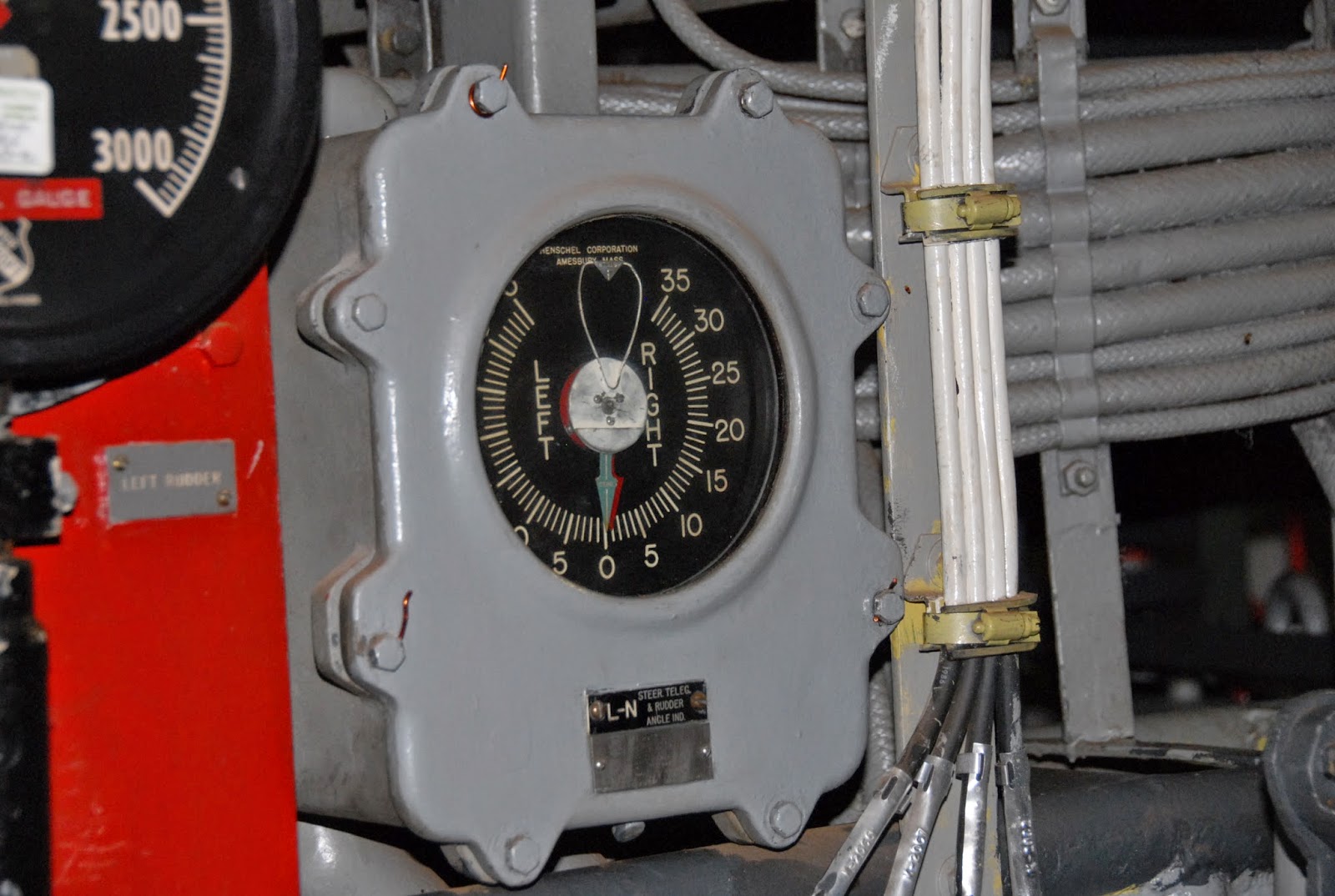
Rudder position indicator:


Aft end of the hydraulic rams that move the rudder. The large round plate in the left foreground is the top post of the actual rudder, and the "dogbones" on either side connect to the rams:


Close up of the brass tag on the dogbone:


Another view looking forward:


The hydraulic diagram of the system. Sorry for the flash hot-spot:


And a drawing listing all the lube points, and what type of grease/lube to use:


So, that was today's behind-the-scenes tour. While we were sitting in the barbershop, the question of "Turret Tours" was brought up. Turret #2, where the accident occurred, is absolutely OFF LIMITS, as it's a memorial to those who died in it. Current plans are being discussed for turret #3, and include putting in a plexiglas "bubble", where people could at least climb partly in to the turret, and look around, and a Virtual Tour" of the turret, being put together by one of our volunteers who's extremely good at taking panoramic photos, and stitching them together, giving views similar to what The Smithsonian does for some of it's aircraft interiors.

I've seen his panoramas of the radio room, and some of the superstructure areas, and their amazing.

Actual tours of the turret, and it's inclusion on the tour route, will require getting all the HAZMAT items out of the turret, and cleaning it up and painting the inside.

Hang on, it's on the "TODO" list for this year!

Saturday, January 10, 2015

Engineering Spaces Tour on the Battleship Iowa on Sunday

For the crew only, and I'm taking my camera!

Some of it I've seen before, but we're going to see the steerage area where the rudders are controlled, and some other things on the 3rd deck.

 Pix to come Sunday evening......

And then on the 27th, I'll be taking a crew only tour of the superstructure.

Pictures will, of course, be posted following that tour......


Saturday, January 3, 2015

"Unbroken" - A Movie of Courage and Valor

We went to see "Unbroken" tonight, and I recommend it to all.

It's the story of Louis "Louie" Zamperini from Torrance, CA, and is based on the book "Unbroken: A World War II Story of Survival, Resilience, and Redemption" by Laura Hillenbrand.

My wife bought the book several months ago, and was waiting for the film to come out.

I haven't read the book yet, but I'll get started on it in the next few days.

It's a stirring movie, and doesn't pull any punches concerning the treatment of Allied POW's in Japan.

Highly recommended, and take a box of Kleenex with you.

Wednesday, December 31, 2014

Loud Music, A Laser Light Show, and Fireworks Going Off

At 2245 local time, that's the extent of New Year's Eve madness in La-La Land.

I suppose things night get a little more nuts, but I'm going to bed.

Hope you all had a safe and sane New Year's Eve, and wishing you all the best for 2015!

Saturday, December 27, 2014

Wonderful "Christmas Present" for Us Radio Guys on the Iowa

God bless the guys at PCS Associates!

During the process of troubleshooting the URR-74(v)2 receivers in the radio room, we've been terribly hampered by a lack of usable documentation.

The WJ 8718 receiver is very close to the URR-74, and we were able to find manuals for that receiver, BUT all the freely downloadable manuals were poor copies made into pdf's.

The worst part was that the schematics were copied with the copier magnification improperly set, resulting in a 1"~2" "gap" in the schematic between the two pages it was spread over!

You couldn't get them to overlap so you could tape them together and get a complete schematic, and in some cases it was cut so badly that complete components and/or circuit blocks were missing.

This makes it rather difficult to follow signals on the schematic, as you're never really sure where they're going between the two pages.

I finally found a place that still supports the Watkins Johnson receivers we have aboard the Iowa, and sent an email asking how much it would cost us to BUY a real, correct copy, stating that we weren't looking for a freebie, and would gladly PAY to get the manuals.

Well, this morning I received an email from a very nice gentleman containing the details of the ftp account he set up for me so I could download the manuals they have available!

I grabbed the manuals, and have been looking at them part of the day.

They manuals are crystal clear, and all the schematics are complete, and not butchered up.

I notified our Grey Radio Gang, and we're going to be working up a nice, official "Certificate of Appreciation" for this gentleman and his company.

Wednesday, December 24, 2014

Merry Christmas, and God Bless Us, Every One!

Hope you all have a very Merry Christmas!


And here's one of my favorite stories from years ago.

"The Star" by Arthur C. Clarke


Forgot to add that we had a Christmas card signing project aboard the Battleship Iowa this year.

We signed and delivered 3051 personalized cards to our troops serving overseas.

"Old School" RTTY Equipment on the Battleship Iowa

Sorry I didn't take more pix of the gear, but I snapped these few after I finished photographing the six HF antennas on the ship.

I took the pix of the antennas so I could document them by their nameplates, and we could compare the what and where of them to the scanty drawings we have.

ANYWHOO....this is a representative of one of the four or five AN/UGC-48A machines abord the Iowa.

This particular one is working perfectly, and has an almost full roll of paper in it.

I am NOT an expert on these by any means, so I can't tell you much about it. In one of my older posts about the equipment in the Comm Center I have a ton of pictures of the RTTY gear, the printers and reperferators, and the CRT-based Data Terminals, which I found out the other day are in working condition. We're trying to find some of the magnetic tape cartridges for them, and supposedly there is a box or two of them stored somewhere on the ship, but this equipment is not on my "TO-DO" list, as I'm more concerned with getting our last non-functioning Watkins-Jenkins AN/URR-74(V)2 receiver working, and learning to replace the chain drives in the 1051 receivers, and the ART-23 exciters.

Nameplate:


Top covers opened:


Close-up of Print Head:


Paper Tape Mechanism:


2nd Tape Mechanism:


2nd Tape Mechanism:


It's definitely neat stuff, but not really in my "knowledge base"!

Sunday, December 21, 2014

A Day at the Workbench

Spent the day catching up on some stuff.

*Cleaned my Kimber 1911

*Cleaned my wife's TRR-8 revolver

And started building the little "Digital Modes Sound Card Interface" for the Kenwood TS-940 we use on the Iowa for CW. The guy who donated it used to be a RTTY operator "Back In The Day", and was blown away when I told him you no longer need a "HAL Interface"


and a lumbering Model 19 Teletype machine to operate Radio Teletype ("RTTY") any longer.


These days, a PC is used to generate and decode audio frequencies corresponding to "Mark" and "Space", and the audio signals are sent to/received from the audio circuits of the radio.

The "nice" thing about doing it this way is that you're no longer limited by the hardware you have to just RTTY. You can also transmit and receive Slow Scan TV, PSK-31, WEFAX, and many other "Digital Modes" on the ham bands.

After I finish and test the little interface, I'll post a few pictures of it.

Friday, December 19, 2014

5 Years here?

Just looked at my settings page, and it indicates I started this blog in January 2009.

Gee.....where'd the time go?

Thursday, December 18, 2014

Damn Blogger and Google!!!

*Something* changed the other day, and now all the comments I make on other blogs are going to my gmail account, which I NEVER look at.

And I can't figure out how to switch it back to my real email address.

Freaking IDIOTS......


*****UPDATE******

Figured out HOW to do it.

Just go here and follow the instructions.


Too bad it nuked all the post replies, but now I'm rid of the ##@@!! gmail address.

Tuesday, December 16, 2014

Finished My RF Safety Report

Had a really nice one about 90% finished that I'd been working on for three days.

Then I was editing a section of it this morning (no coffee!), and I NUKED the whole damn document..............RATS!

Just finished a frantic 6 hour push to get at least something presentable printed out.

The question of RF Safety on the Iowa is something that's a bit overblown, as getting to the Disc/Cage antenna on the bow means going through a locked gate that only authorized people have the key for. The public can't get within 50 feet of it.

The Trussed Monopole antenna at the stern is located on top of the Helo Ops shack, and is a good 10' above the deck.

Assuming ZERO feedline loss (we don't have a clue what the line loss is, but I'll bet it's at least 2~3dB), the fact that we run *maybe* 100 Watts out of the transmitter, and the fact that the Duty Factor for SSB is 20%, and CW is 40%, the minimum safe distance for the "Uncontrolled Area" (where the public is allowed) is FIVE feet.

There's just no way we're pumping out enough RF to do anything to anybody.

Sunday, December 14, 2014

Got Those "Term Paper" Blues......

Well, not exactly a "Term Paper", but it makes me glad I wrote all of them in high-school and College.

I've been asked to do a short report on RF Safety, and how it pertains to the Amateur Radio operations aboard the Iowa.

Actually, I was asked to do a full report, and oh, by the way, can you have a short one available for our meeting this Wednesday?

Now, all the Hams I know are quite conversant on RF Safety, and we've all performed our FCC mandated RF Evaluations of our stations.

I don't know a single Ham who has not done this, and nobody I know has a station that doesn't meet the requirements.

The "problem" arises when you say "RADIATION" around most lay people, who don't know the difference between an X-ray, cosmic ray, a sun ray, or even a "Ray of Hope". All you have to do is mention "RADIATION", and people start thinking of giant ants, giant grasshoppers, or Big Things We Accidentally Created/Let Loose/Got Pissed Off.

Since Radio Frequency radiation is NON-Ionizing, it's extremely unlikely to cause gigantic tomatoes and bugs to start appearing under your antenna. It just doesn't work that way.

The primary harm the high levels of RF can cause, are thermal hazards, similar to sticking something into your microwave oven and cranking it up.

And even that has requirements to be met before the object will heat up.

It's true that in the "Olde Days" Diathermy used a frequency in the vicinity of 30 MHz, but the patient was positioned in almost direct contact with the antenna, and the antenna was designed to concentrate the RF field into a very small area.

They weren't having people stand under a half-wave dipole and applying 100 Watts to it.

So, I'm writing this with the LCD principle, trying to make it simple so non-technical people can understand it, while keeping it technically accurate, and not boring the people that actually understand it.

I just hope it doesn't get picked apart by the people who are "just too busy" to take this task on themselves, but yet not so busy that can find the time to read it, and nit-pick it to death.....

SLW's BFF Passes Quietly

 On Friday, the 29th, and 1215pm local time. Surrounded by family and friends, and her two dogs. Things have been a bit hectic here, as expe...